Fortifying Your Herd: Biosecurity and Boarding Facilities
By Claire Halden
A practical biosecurity checklist for boarding barns and horse owners, covering isolation, traffic, pest control, and a written protocol.
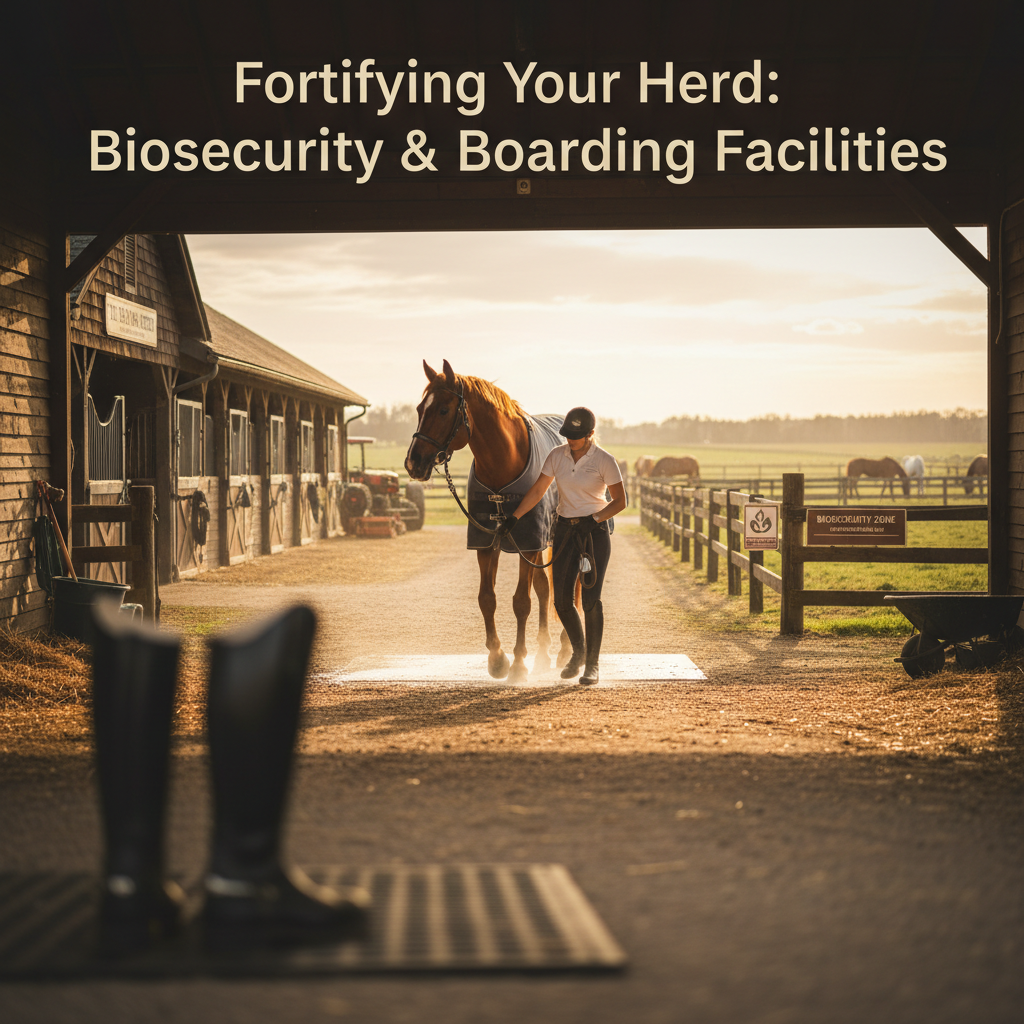
This article is educational. It is not a veterinary protocol and not a legal standard of care. Outbreak response, isolation length, and vaccination schedules belong to your veterinarian and, where they apply, to provincial animal-health rules.
A boarding barn is a shared airspace, a shared aisle, and often a shared water trough. That is the point of the place, and it is also the risk. Infectious disease can move by direct contact between horses, and by indirect routes: shared buckets, tools, hoses, trailers, and visitors. A protocol is a set of everyday barriers, not a slogan.
What remains is a protocol you can actually walk during a barn tour, plus an audit list for the person who runs the barn. If you board, use it with Beyond the Brochure and How Much Does It Cost to Board a Horse in Alberta?. Isolation stalls and "extra labour for a new arrival" are fee questions as well as health questions; run them through the boarding cost calculator. Written rules belong in a boarding agreement; see Horse Lease and Boarding Agreements, and treat templates as not legal advice.
What to ask a boarding barn
Vaccination and health records. What is required, on what schedule, and who verifies it for new arrivals? Horses that travel may be on a different influenza or herpesvirus rhythm than horses that never leave; that is a veterinary decision, not a blog calendar. Ask whether visiting horses — clinic participants, a friend's horse on the trailer, sometimes even a farrier's unscheduled extra — must show proof. A barn that cannot answer is telling you something.
Isolation of new arrivals. Is there a physically separate stall or paddock, with its own buckets, forks, and, if possible, separate air and runoff? Who cares for that horse, and do they handle the resident herd first or last? There is no single official isolation length in the sources below. Ask your veterinarian how long a new horse should be kept apart, and what would shorten or lengthen that period. If the barn says "they go straight into the field," decide whether you accept that risk.
Hygiene. Stalls and aisles picked and, when a sick horse has been in them, cleaned and disinfected with a product meant for that job, used at the dilution on the label. Water troughs and buckets scrubbed. Feed kept in closed containers, off the floor, and away from the manure pile. Shared grooming tools, bits, and twitches washed between horses, or not shared. Manure stored away from feed and the well, and managed so it is not a fly factory. The Alberta manure-and-pasture guide's 20 kg (45 lbs) of manure per horse per day is a reminder that this is a daily system, not a spring clean-up.
People and traffic. A visitor policy: where cars park, whether the public walks the aisle, a place to wash hands, and a rule about moving from a sick stall into the main barn. Show-season traffic — horses leaving and returning, borrowed trailers, borrowed tack — is a separate, higher-risk pattern. The audit-style companion post's useful point, kept here: clean a trailer after it has hauled a sick or unknown horse, and do not treat "we all go to the same show" as sanitation.
Watching the herd. Someone who sees the horses every day should know what "normal" looks like for each one: appetite, manure, nasal discharge, fever if a thermometer is part of the protocol, and sudden dullness. Record-keeping does not have to be fancy. It has to exist when the veterinarian asks who got sick first.
Pests. Standing water, spilled grain, and an open manure pile feed flies and rodents. University of Minnesota treats pest control as biosecurity, not as cosmetics.
If you run the barn: an audit, not a slogan
Walk the property as a stranger would. Where would a new horse go tonight? Where would a feverish horse go at 2 a.m.? Is there a written protocol that staff and boarders have actually read? Are buckets the same colour in the isolation stall as in the show barn? Who is allowed to borrow a hose?
If you run the barn, walk it as a stranger would. Are isolation and wash areas clearly marked? Have staff actually been shown the protocol? Who calls the veterinarian, and who calls the other boarders? Consider how horses, people, and equipment move: a "clean" and "dirty" path, or at least a rule about not walking from a sick stall into the main aisle, is part of the same audit. Keep a simple daily record of appetite, manure, and anything odd, so you know who got sick first.
Regional disease risk and any movement or notifiable-disease rules are a provincial animal-health and veterinary question. Ask those officials or your veterinarian for the current procedure; this article is not a quarantine statute.
Prevention still costs less than an outbreak, but we will not put a fake number on either side of that sentence. A biosecurity kit (gloves, disinfectant used as labelled, dedicated buckets and forks) is a line on the barn P&L; see How to Build a Boarding Barn Profit-and-Loss Statement.
If a horse looks contagious, separate it, stop unnecessary traffic, call the veterinarian, and follow their instructions about the rest of the herd. Do not diagnose EHV, strangles, or influenza from a search result.
FAQ
What is the single most important biosecurity step for a new horse? Keep it apart, with its own equipment, for a period your veterinarian recommends, and confirm vaccination and recent health history before it meets the herd.
Can I use household bleach in the barn? Only if a veterinarian or a labelled disinfectant protocol says so, at a stated dilution, on a clean surface, with an understanding of what bleach does not kill and how quickly it goes off. Do not invent a mixing recipe from a blog.
How often should shared tools be cleaned? Between horses is the practical standard when tools are shared at all. Dedicated tools are better in isolation.
What should I do if I suspect a contagious disease? Isolate, call your veterinarian, and limit traffic. If you are a boarder, call the barn first so they can protect the other horses.
Do visitors and clinic horses matter? Yes. Ask the barn for a visitor and visiting-horse policy, and follow it when you are the visitor.
Sources
- Alberta Agriculture, Food and Rural Development, Lori K. Warren and Christine Sweet, Manure and Pasture Management for Horse Owners (PDF created 2004), manure volume. https://www1.agric.gov.ab.ca/$department/deptdocs.nsf/ba3468a2a8681f69872569d60073fde1/3d52f2f2a596cca78725827200722bb4/$FILE/Manure_and_Pasture_Management_for_Horse_Owners.pdf
- Disease-response and isolation length are left to the attending veterinarian.
This article is general information, not veterinary advice. Talk to your veterinarian about your horse.