Mastering Equine Property Drainage: Mud & Erosion Solutions
By Mark Dunlop
Poor drainage on equine properties leads to persistent mud, increased health risks, and costly erosion. Learn how to assess, prevent, and mitigate these issues with effective drainage strategies.
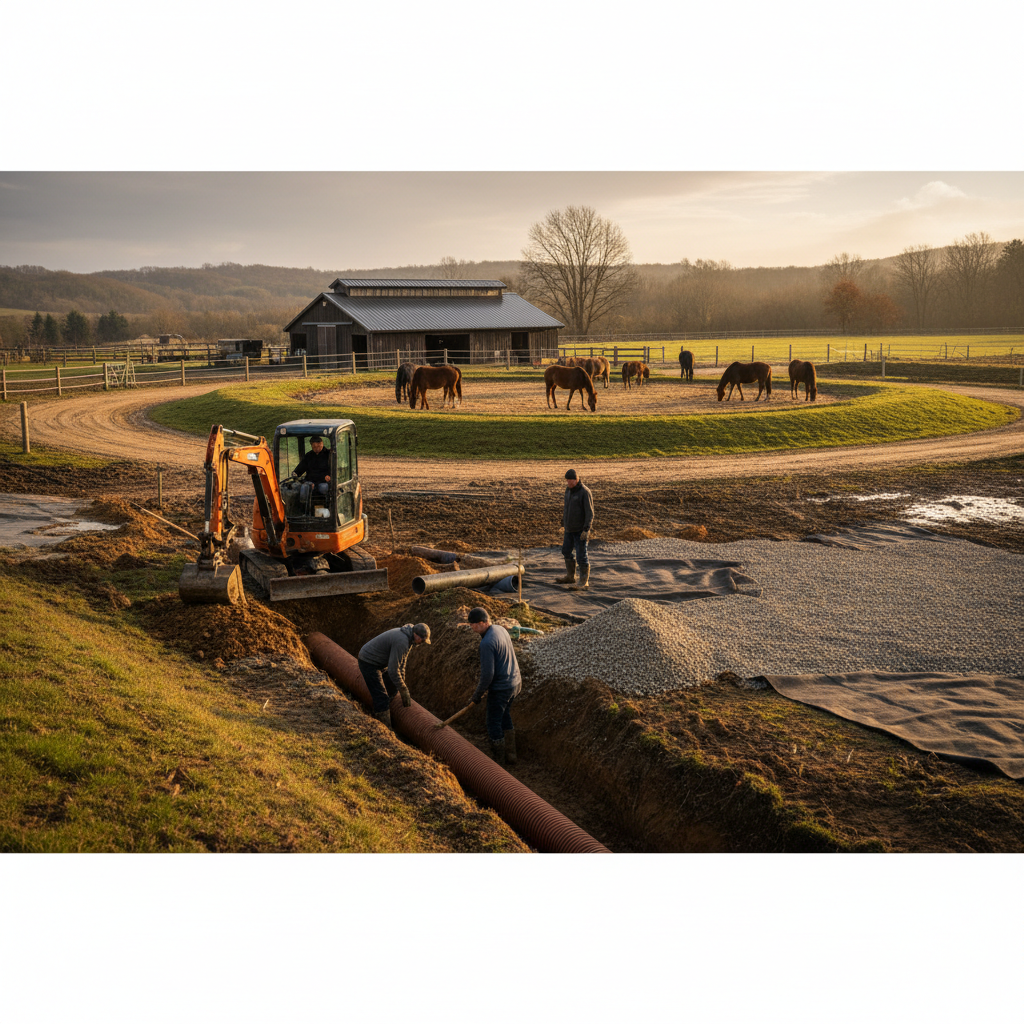
More than 90% of equine properties in regions with moderate to heavy rainfall experience significant mud and erosion challenges. Beyond being an unsightly nuisance, poor drainage creates serious health hazards for horses, compromises hoof integrity, and leads to costly property damage over time. Effective drainage management is not merely an aesthetic concern; it's a fundamental aspect of responsible horse ownership and barn management.
This article provides a comprehensive guide to evaluating your equine property's drainage, identifying problem areas, and implementing practical solutions to mitigate mud and erosion. We'll cover everything from site assessment to specific mitigation techniques, ensuring your horses stay healthier and your property remains structurally sound.
Understanding the Impact of Poor Drainage
Persistent mud and standing water on a horse property can lead to a cascade of problems. From a health perspective, constant exposure to wet conditions softens hooves, making them more susceptible to conditions like thrush, white line disease, and abscesses. The American Association of Equine Practitioners (AAEP) frequently highlights the importance of dry conditions for hoof health, noting that prolonged moisture can weaken the hoof capsule.
Beyond hooves, mud can harbor bacteria and parasites, increasing the risk of skin infections such as rain rot and scratches. Furthermore, horses expending extra energy navigating deep mud may experience increased fatigue and potential soft tissue injuries. For barn managers, mud around feeding areas can also complicate accurate feeding, potentially affecting a horse's caloric intake, which can be assessed using a Horse Feed Calculator for proper nutrient management.
Erosion, the long-term consequence of uncontrolled water flow, can destabilize fencing, damage structures, and wash away valuable topsoil. This not only diminishes the aesthetic appeal of your property but can also lead to significant repair expenses. For instance, a collapsed fence line or an undermined barn foundation due to erosion can cost thousands to rectify.
Initial Site Assessment: Where to Start
The first step in addressing drainage issues is a thorough site assessment. This involves observing your property during and after rainfall to identify how water flows and where it accumulates. Look for:
- Standing water: Puddles that persist for more than 6-12 hours after rain indicate poor percolation or a low spot.
- Muddy areas: High-traffic zones like gates, sacrifice paddocks, and around water troughs are common culprits.
- Erosion channels: Observe areas where soil has been visibly moved or carved out by water flow, often downhill.
- Runoff paths: Note how water moves across hard surfaces like driveways and barn roofs, and where it eventually goes.
Topography and Soil Composition
Understanding your property's topography is crucial. Gentle slopes (typically 2-5% grade) are ideal for directing water away from critical areas. Areas with less than a 1% grade are often prone to standing water, while slopes exceeding 10% can be highly susceptible to erosion if not properly managed.
Soil composition significantly impacts drainage. Sandy soils drain quickly, while heavy clay soils are dense, retain water, and drain very slowly, leading to prolonged mud. The USDA's Natural Resources Conservation Service (NRCS) provides soil surveys for most regions, offering detailed information on soil types and their drainage characteristics. For example, a "silty clay loam" might have an infiltration rate of less than 0.2 inches per hour, compared to a "sandy loam" which could exceed 2 inches per hour.
Existing Infrastructure Evaluation
Inspect current drainage features: downspouts, French drains, culverts, and ditches. Are they properly sized, free of obstructions, and directing water effectively away from structures and paddocks? Clogged gutters or undersized culverts can negate any other drainage efforts.
Practical Drainage Solutions and Mitigation Strategies
Once problem areas are identified, a range of solutions can be implemented. Often, a combination of techniques yields the best results.
1. Regrading and Land Contouring
Strategic regrading can create positive drainage, directing surface water away from high-traffic zones and structures. This often involves creating a slight slope (e.g., 2% away from buildings) or installing swales – broad, shallow, vegetated channels – to collect and move water gradually. Hiring a professional with equine property experience for significant regrading projects is often advisable to ensure proper engineering and prevent future issues.
2. Improving High-Traffic Areas with Footing
Sacrifice paddocks, gate entries, and feeding areas are notorious for mud. Implementing robust footing systems in these zones can drastically reduce mud. Common options include:
- Geotextile fabric: A heavy-duty, permeable fabric laid over compacted sub-base, preventing aggregate from sinking into the soil.
- Crushed rock/gravel: A base layer of 3-6 inches of coarse aggregate (e.g., 1-2 inch crushed rock) followed by a 2-4 inch layer of finer material (e.g., 3/4 inch washed stone or screenings). "The Horse" magazine often features articles detailing these footing solutions, emphasizing layers for longevity.
- Reinforced grids: Plastic grids (e.g., Ecoraster, GEOWEB) interlock to stabilize the surface and prevent compaction, suitable for areas with heavy use. These can be filled with gravel, sand, or wood chips.
3. Surface Water Diversion
- French Drains: Trenches filled with gravel and a perforated pipe, wrapped in geotextile fabric. These collect subsurface water and direct it away. A typical French drain might be 6-12 inches wide and 18-36 inches deep, depending on water volume.
- Swales & Ditches: Open channels designed to collect and convey surface runoff. They should have gentle slopes and be vegetated to prevent erosion. A properly designed swale might be 1-2 feet deep with a 4:1 side slope.
- Rain Gutters & Downspouts: Crucial for barns and run-in sheds. Ensure downspouts direct water into a controlled system, such as a buried pipe leading to a vegetated area or a dry well, rather than simply discharging next to the foundation.
4. Subsurface Drainage Systems
For areas with high water tables or persistent saturation, subsurface drainage might be necessary. This involves a network of perforated pipes buried below grade, collecting water and channeling it to an outlet. These systems are more complex and usually require professional design.
5. Vegetation Management
Healthy pastures and vegetated areas are excellent natural sponges. Grass roots help bind soil and increase water absorption. Avoid overgrazing, especially in low-lying areas, and consider planting water-tolerant species in naturally wet zones. Rotational grazing can also help manage pasture health and prevent compaction in specific areas.
6. Managing Water from Manure Piles
Manure piles, if not properly managed, can contribute significantly to runoff and water contamination. Locate manure storage on high ground, away from waterways and wells. Construct a concrete pad or a compacted gravel base with a slight slope to direct leachate to a collection point. Consider composting to reduce volume and environmental impact.
Cost Considerations and Professional Assistance
Drainage projects can range from DIY solutions costing a few hundred dollars for gravel and hand tools to extensive professional projects costing tens of thousands. For example, installing 100 feet of basic French drain might cost $1,000 - $3,000 for materials and labor, while a comprehensive regrading and footing project for a 1-acre sacrifice paddock could easily exceed $10,000 - $20,000. Consulting with an engineer specializing in rural or equine properties can save money in the long run by ensuring the right solution is implemented the first time. They can also help estimate costs for materials like gravel or stone, which vary regionally; for instance, a ton of crushed aggregate might cost $25-50 in some areas but $60-100+ in others.
While some tasks are manageable for a homeowner, complex grading, extensive French drain systems, or subsurface drainage often warrant professional expertise. Mismanaged drainage can lead to greater problems down the line. Remember, every property is unique, and a one-size-fits-all approach rarely works.
Long-Term Maintenance for Sustainable Drainage
Drainage systems require ongoing maintenance to remain effective. Regularly inspect and clear gutters, downspouts, and culverts of leaves, debris, and sediment. Periodically check French drains for clogs and repair any eroded areas promptly. Maintaining healthy vegetation in swales and pastures is also key. Proactive maintenance is far less costly and time-consuming than emergency repairs.
Frequently Asked Questions (FAQ)
Q: How often should I inspect my property for drainage issues?
A: It's best to conduct a thorough inspection after every significant rainfall event and at least semi-annually. Pay close attention during spring thaws and heavy summer rains, which often reveal problem areas most clearly.
Q: Can I use wood chips for mud control?
A: Wood chips can be a temporary solution for mud, especially in low-traffic areas, as they absorb moisture and provide some cushioning. However, they decompose over time, requiring replenishment, and can create an uneven surface. For high-traffic areas, a more durable aggregate-based footing system is generally recommended.
Q: What role does my horse's weight play in drainage issues?
A: Heavier horses and greater horse density on a given area increase soil compaction, which directly impairs drainage. Soil compaction reduces infiltration rates, meaning water sits on the surface longer, contributing to mud. Understanding your horse's weight (which you can estimate using a Horse Weight Calculator) can help you assess the compaction potential in high-traffic zones and plan appropriate footing solutions.
Q: Is it better to install a French drain or just dig a ditch?
A: Both have their uses. A French drain is excellent for collecting subsurface water and maintaining a relatively clean, usable surface, making it suitable near barns or high-traffic paths. An open ditch or swale is better for conveying large volumes of surface water over longer distances or for defining property boundaries, but it requires more space and can be an obstacle for horses.
Q: How do I know if my existing culverts are appropriately sized?
A: Culvert sizing depends on the expected water flow volume, the upstream drainage area, and the slope. Undersized culverts can cause water to back up and flood. If you observe water overflowing or backing up around your culverts during heavy rain, they are likely too small or partially obstructed. A civil engineer or experienced excavator can assess and recommend proper sizing. For basic estimation, the USDA's NRCS offers guidelines on culvert sizing based on drainage area characteristics.
Effective drainage management is an investment in your property's longevity and your horses' health. By systematically evaluating your land, understanding soil dynamics, and implementing appropriate solutions, you can transform muddy, eroded areas into functional, safe spaces for your equine partners. Prioritize prevention, regular maintenance, and don't hesitate to consult professionals for complex challenges.
This article is general information, not veterinary advice. Talk to your veterinarian about your horse.