Arena Footing Guide: Selection, Maintenance, Dust & Cost
By Mark Dunlop
Selecting the right arena footing requires balancing mechanical grip, base compaction, and dust control to protect horse soundness. Learn engineering specs, daily maintenance protocols, and real-world refurbishment costs.
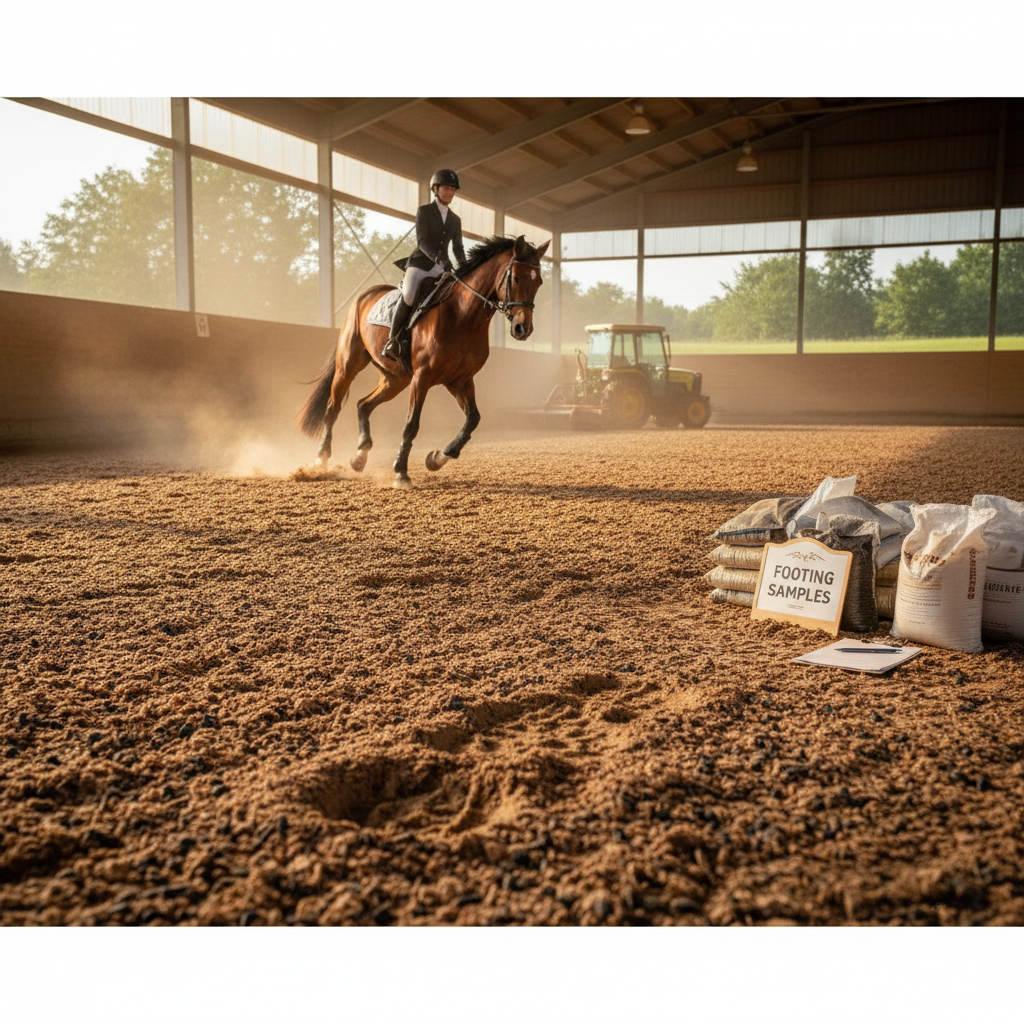
A 1,200-pound warmblood landing from a 1.20-meter vertical generates a peak impact load exceeding 2.5 times its body weight on a single forelimb. If your riding surface is too hard, that energy travels straight into the navicular apparatus and coffin joint; if it is too deep or shears underfoot, the superficial digital flexor tendon and suspensory ligament absorb excessive strain.
According to epidemiological studies highlighted by the American Association of Equine Practitioners (AAEP), irregular, poorly compacted, or shifting footing ranks among the top non-genetic contributors to chronic lameness. Yet, footing is frequently treated as an afterthought—dumped sand spread thin over an unengineered sub-base.
Whether you operate a commercial boarding facility or manage a private dressage barn, selecting the right footing material, executing daily maintenance, controlling dust, and budgeting for eventual refurbishment are critical to safeguarding equine orthopedics and business viability.
1. Arena Footing Selection: Matching Material to Discipline
No universal footing exists. The ideal surface balances five mechanical properties defined by the Equine Surfaces White Paper (published by the Fédération Équestre Internationale / FEI): impact firmness, cushioning, responsiveness, grip, and uniformity.
+-------------------------------------------------------------+
| Top Layer: Footing Blend (2.0" - 3.5" Sand / Wood / Wax)    |
+-------------------------------------------------------------+
| Separator: Geotextile Fabric / Elastic Grid (e.g., OTTO)    |
+-------------------------------------------------------------+
| Base Layer: Compacted Crushed Stone / Dense Base (4" - 6")  |
+-------------------------------------------------------------+
| Sub-Base: Native Soil / Laser-Graded Slope (1-2%)           |
+-------------------------------------------------------------+
Sand: Grain Shape and Mineralogy Matter
Sand forms the backbone of most arenas, but ordering generic "fill sand" is a catastrophic mistake:
- Grain Shape: You need sub-angular to angular grains. Rounded grains (like river-washed pea gravel or beach sand) act like ball bearings under hoof, offering zero shear strength and causing horses to slip. Very angular quarry dust packs into concrete.
- Mineral Composition: Quartz and silica sands are significantly harder than limestone, granite, or feldspar. Pure silica resists pulverizing under hoof traffic, lasting 8 to 12 years before breaking down into airborne dust. Limestone breaks down within 24 to 36 months under moderate use.
- Particle Size Distribution: Aim for medium-to-coarse sands between 0.15 mm and 0.40 mm. Avoid sands with high clay or silt content (more than 3% fines passing a #200 sieve) in indoor rings, as they cement when dry.
Synthetic Additives: Geotextiles and Fibers
For disciplines requiring explosive push-off and stability—such as show jumping and barrel racing—uncoated sand shifts too much. Adding a blend of chopped non-woven geotextile felt and polyester fibers (typically 1.5 to 3 lbs per square foot) creates a root-system effect. The fibers lock sand grains in place, increasing shear resistance while cushioning downward impact.
Wax-Coated Footing
Common in elite European dressage and jumping barns, wax-coated surfaces blend silica sand, synthetic microfibers, and a proprietary paraffin wax.
- Pros: Completely dust-free, requires zero water, and offers exceptional rebound.
- Cons: Cost is prohibitive ($8 to $12 per square foot installed), and the wax can stiffen in extreme freezing temperatures or degrade under intense, direct southern US heat.
Wood Products (Shredded Bark / Pine)
Popular in the Pacific Northwest and parts of the Northeast, wood chips or shredded cedar provide natural cushioning and cost-effective traction. However, wood decomposes rapidly (requiring top-offs every 18 months), turns slippery when saturated, and holds moisture inconsistently.
Summary: Discipline Matchup
- Dressage: 2.5 to 3.0 inches of silica sand blended with 20–30% geotextile felt; requires high cushioning and moderate grip.
- Show Jumping: 3.0 to 3.5 inches of angular silica with heavy fiber content for traction during sharp turns and high shear resistance at takeoff.
- Reining / Western Performance: 2.5 to 3.5 inches of loose, round-to-sub-angular sand over an ultra-smooth, hard base (often clay-hardpan) to allow sliding stops without grabbing the hoof.
- Hunters: 2.5 inches of sand/fiber blend; emphasis on a level, consistent take-off and soft landing.
2. Base Construction: The Invisible Foundation
Eighty percent of footing failures stem from base failures, not the surface sand. A proper arena requires a multi-layered profile:
- Sub-Base (Native Soil): Excavated and compacted to 95% Standard Proctor density, graded with a 1% to 1.5% crown or cross-slope for outdoor rings.
- Base Layer: 4 to 6 inches of dense-graded aggregate (such as road base, crushed rock with fines, or lime rock), compacted with a heavy vibratory roller until water cannot easily penetrate it.
- Transition / Drainage Layer: In premium outdoor builds, permeable polypropylene grids (e.g., OTTO Sport, ProGrid) sit over the base, filled with small gravel to allow instant vertical drainage while preventing horse hooves from digging into the sub-base.
3. Maintenance Protocols: Grooming, Depth, and Moisture
A $50,000 arena surface can be ruined in six months without routine, disciplined maintenance.
       MAINTENANCE CADENCE
Daily:      Manure removal, drag traffic lanes
Weekly:     Hand-rake edges/corners, depth probe check
Monthly:    Base inspection, drag tine recalibration
Quarterly:  Deep conditioning, grader laser verification
Depth Verification
Use a simple depth gauge or marked screwdriver to check footing depth at 10 random points weekly. Horses naturally displace material outward from the rail toward the center, creating deep pockets along the track and exposing the base along the boards.
Riders on heavier mounts will pack footing faster; if you track equine performance closely or balance commercial barn metrics alongside your feeding program, estimating load changes via a Horse Weight Calculator helps you correlate wear-and-tear with horse size and stocking density.
Dragging Mechanics
- Tine Depth: Set your arena drag tines to loosen the top layer without ever touching the base. If your sand is 3 inches deep, your tines must run no deeper than 2 to 2.25 inches. Piercing the compacted base drags stone into your sand, ruining the surface permanently.
- Drag Selection: Rotary drags work best for round pens and tight corners. S-tine cultivators followed by a crumbler roller or coil packer are best for fiber-sand blends to re-incorporate fiber that floats to the surface.
- Pattern Variation: Alternate dragging patterns (straight laps, figure-eights, spiral circles) to prevent building ridges.
4. Dust Control Systems: Air Quality & Equine Respiratory Health
According to research reported by The Horse magazine and veterinary respiratory specialists, barn dust contains respirable particles (<10 microns) laden with silica, endotoxins, and mold spores. Inhaling these during exercise triggers inflammatory airway disease (IAD) and equine asthma, reducing lung capacity.
+------------------------------------+--------------------------+-----------------------+
| Method                             | Application Cost         | Annual Upkeep / Notes |
+------------------------------------+--------------------------+-----------------------+
| Overhead Automated Sprinklers      | $7,000 - $18,000 (setup) | Water utility costs   |
| Magnesium Chloride (Dry Flakes)    | $0.15 - $0.25 / sq. ft.  | Reapply 1-2x per year |
| Synthetic Oil/Polymer Treatments   | $0.60 - $1.10 / sq. ft.  | Lasts 18-36 months    |
| Wax Coating (Self-Moisturizing)    | Built into footing cost  | Periodic re-coating   |
+------------------------------------+--------------------------+-----------------------+
Automated Sprinklers vs. Water Wagons
- Overhead Sprinklers: Wall-mounted or truss-hung rotators provide hands-off coverage. However, they struggle with drift in drafty indoor arenas and leave dry shadows near walls. Budget $7,000 to $18,000 for installation.
- Water Wagons / PTO Spreaders: Highly uniform when calibrated, but labor-intensive.
Chemical and Hygroscopic Treatments
- Magnesium Chloride ($MgCl_2$): A hygroscopic salt that draws moisture directly from ambient air. Applied in flake form (typically 1.5 to 2 lbs per square yard initially), it eliminates freezing in winter and drastically cuts watering needs. Avoid calcium chloride if horses lie down, as it can cause skin and hoof drying.
- Polymer & Bio-Fluid Emulsions: Non-toxic synthetic oils coat sand particles, adding weight so fines cannot become airborne. While expensive upfront, they eliminate the need for thousands of gallons of water annually—vital in drought-prone western states.
5. Refurbishment Costs and Budgeting
Arena surfaces have a finite lifespan. Commercial boarding barns managing tight profit margins—where feed, labor, and bedding already consume gross revenue—must account for footing depreciation. Barn managers tracking expenses through a Hay Bale Cost Calculator understand how small operational variances impact margins; arena footing requires identical analytical rigor.
For a standard 80' x 160' indoor arena (12,800 sq. ft.), expected replacement and refurbishment costs in the US run as follows:
Minor Refurbishment (Every 3–5 Years)
- Re-grading and leveling: $1,500 – $3,000
- Top-off sand (1–2 inches, ~60–80 tons silica): $3,500 – $6,000
- Felt/Fiber replenishment (800–1,200 lbs): $2,000 – $3,800
- Total: $7,000 – $12,800
Full Overhaul (Every 8–12 Years)
- Old footing stripping & disposal: $4,000 – $7,500
- Base laser-grading and re-compaction: $3,500 – $6,000
- Base repairs / Patching: $1,500 – $4,000
- New premium silica sand (150 tons delivered): $9,000 – $15,000 (subject to quarry proximity)
- New synthetic additive package: $6,000 – $10,000
- Laser-guided installation & blending: $3,500 – $5,500
- Total: $27,500 – $48,000
Regional Note: Facilities in the Mid-Atlantic and Northeast often benefit from closer proximity to high-grade industrial silica deposits (New Jersey/Pennsylvania), lowering freight costs by up to 40% compared to Mountain West or Southwest venues, where long-distance trucking adds thousands in diesel surcharges.
Frequently Asked Questions
How deep should arena footing be for jumping versus flatwork?
For jumping, maintain a settled footing depth of 3.0 to 3.5 inches. This provides sufficient energy attenuation upon landing without shifting under takeoff. Flatwork and dressage generally perform best at 2.5 to 3.0 inches, ensuring stability and preventing fatigue in the deep digital flexor tendons.
Can I mix wood chips into existing sand footing?
You can, but it is rarely recommended by footing experts. Wood chips and sand have different densities; wood floats to the surface during dragging and breaks down into fine organic matter within two years. When decomposed wood mixes with sand, it traps dust and creates slick, inconsistent mud pockets when wet.
How often should an arena be dragged in a busy boarding barn?
In facilities seeing 15 or more rides per day, groom the footing at least once daily, with a mid-day touch-up if high-traffic jumping or lunging lessons occur. Regular harrowing redistributes moisture, levels the track, and prevents sub-surface shear planes from hardening.
Will magnesium chloride ruin my horse’s hooves?
Magnesium chloride is significantly gentler than standard rock salt or calcium chloride. However, continuous exposure to dry, salted footing can sap moisture from the hoof wall and frog. Apply a conditioning hoof oil or barrier cream to the coronary band and sole, and rinse the horse's lower legs after riding on salt-treated footing.
This article is general information, not veterinary advice. Talk to your veterinarian about your horse.