Automatic Waterers: Selection, Installation, and Freeze Guide
By Claire Halden
Choose and winterize automatic waterers with official intake figures, Alberta grounding advice, and a link to the winter water-and-feed article.
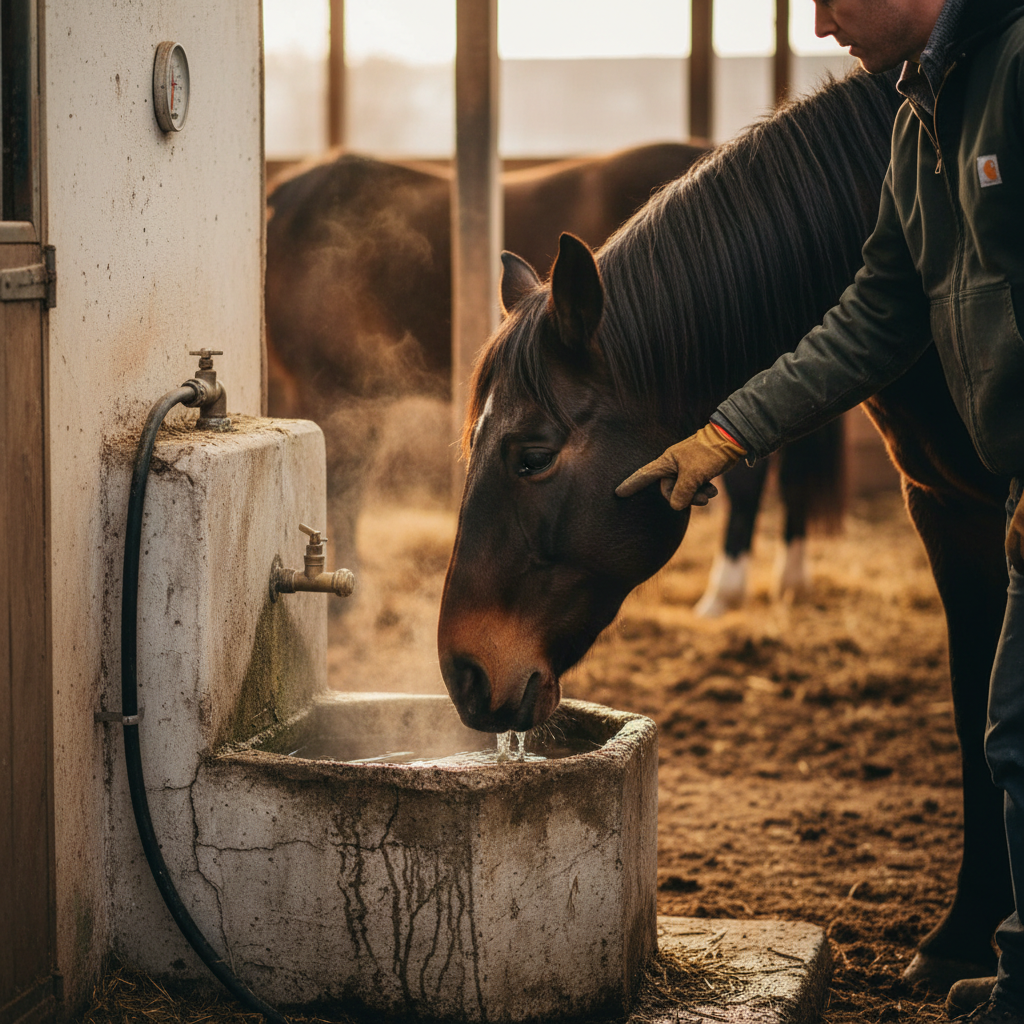
This article is educational. It is not an electrical or plumbing specification. Electrically heated waterers and buried lines should be installed by qualified people, with the permits Alberta's safety-codes system requires.
An automatic waterer only earns its keep if the horse actually drinks, and if the water is still water when the temperature is well below freezing. Use the published water-intake ranges below, and get a local install quote rather than a generic station price.
Official intake ranges we did open, and that do not perfectly agree, are:
- North Dakota State University Extension (Carrie Hammer, 29 January 2013): an average adult horse will drink 5 to 10 gallons per day.
- University of Minnesota, winter care (reviewed 2022): most 1,000-pound adults need at least 10 to 12 gallons daily; keep water between 45°F and 65°F (about 7°C to 18°C). Research cited there found ponies increased intake by about 40 percent when water was above freezing in cold weather.
- University of Minnesota, "Encouraging your horse to drink" (reviewed 2021): a 1,000-pound horse should drink about 8 to 10 gallons daily.
This article reports those ranges as published. In an Alberta winter, the practical rule is the one in Winter Water and Feed for Horses in Alberta: offer unfrozen water, check it at least twice a day in a freeze, and do not rely on snow (Agdex 460/50-4, reviewed August 2009). Dried winter hay is a dry diet; Minnesota notes winter feedstuffs often contain less than 15 percent moisture, versus lush pasture at 60 to 80 percent, so the horse must drink, not less, when it is on hay. If a horse stops drinking it may eat less and be more prone to impaction colic (UMN; NDSU).
Types, without a fake price list
Three families are a fair shopping list:
- Stall-mounted bowls or paddles, one per stall or shared between two, with a shutoff you can actually reach when a stall floods.
- Heated pasture or paddock units, often on a fence line, serving more than one pen.
- "Energy-free" or earth-thermal units, which rely on ground temperature and design rather than a heating element, and which still need to be sited and maintained for an Alberta freeze — do not treat the name as a guarantee.
Alberta Agriculture's Horse Handling Facilities (Agdex 460/722-1, revised 1985) already described individual automatic waterers with a shutoff and a way to keep water from freezing, and large electrically heated units for corrals, placed on a well-drained site with a concrete apron 1.8 to 3 m wide. That is official, dated design advice, not a 2026 catalogue.
Installation and freeze protection
Have a licensed electrician and a plumber or experienced installer do the buried work. Alberta's safety-codes system requires the appropriate permits for electrical (and other) work that falls under the Safety Codes Act; the owner is responsible for compliance, and a safety codes officer may inspect. A February 2014 Alberta Electrical Safety bulletin (CEC-22, rev-4) discusses Canadian Electrical Code Rule 22-204, wiring methods in buildings housing livestock and poultry, and notes that whether ventilation is "adequate" for certain wiring methods can be a question for a Safety Codes Officer. This article will not pretend to interpret that rule for your barn.
The 1985 Agdex fact sheet is direct: electrically heated waterers must be properly grounded to prevent electric shock to the person or the animal. If horses sip and back off, or if you feel a tingle, shut the unit down and call a qualified electrician. Inspect heating-element and heat-tape cords for damage, as Minnesota also advises.
Other practical points that do not need a price tag:
- Put the unit on a pad that drains, with enough hard footing that the area does not become a mud hole (the 1985 apron dimensions are a starting point).
- Give yourself a shutoff, a drain, and a way to scrub algae and sludge. Dirty water is a reason horses stop drinking.
- Below-frost buried lines, heat tape, thermostats, and circulation loops are design choices for a qualified installer on your site, not a blog diagram.
- Energy-free units still need winter checks. "Energy-free" is not "attention-free."
- Budget electricity honestly. The October 2026 Alberta farm-input survey lists electricity, farm use, excluding service or delivery charge, at $11.93 per 100 kWh. That is not a heated-waterer operating cost; it is the official energy-price line. Add your actual rural service charges from the bill.
Labour savings are real if the alternative is hauling buckets. If you hire help, the same survey's general farm labour average is $4,147.94 per month, full-time, without board — a provincial farm-labour line, not a barn-hand wage scale.
Teach a horse that has only known buckets by holding the paddle or showing the bowl, and watch intake for several days. Keep a backup bucket available in a hard freeze or a power outage. Salt (Minnesota: one to two ounces daily for many adults, loose salt rather than a cold block) supports drinking; electrolytes without a plain-water source can worsen dehydration.
FAQ
Can an automatic waterer cause impaction colic? A waterer that is frozen, empty, or shocking horses can cut intake, and low intake on a dry hay diet raises impaction risk (NDSU; UMN). The machine is not the disease; the missing water is.
What water pressure do automatic waterers need? Follow the manufacturer's specifications for pressure and flow; the sources below do not set a single official PSI range.
How do I teach a horse to use a paddle or bowl? Show the moving part, hold it down so the horse sees water, and watch the first days. Keep a bucket as a backup until you are sure.
Are energy-free waterers frost-proof in Alberta? Not by the name alone. Site them, maintain them, and check them in a cold snap the same way you would a heated unit. Do not rely on snow.
Where should I read about winter intake and extra hay? Winter Water and Feed for Horses in Alberta, and the horse feed calculator.
Sources
- North Dakota State University Extension, Carrie Hammer, "Feed Horses Properly in Winter" (29 January 2013). https://www.ag.ndsu.edu/news/newsreleases/2013/jan-28-2013/feed-horses-properly-in-winter
- University of Minnesota Extension, "Caring for your horse in the winter" (reviewed 2022) and "Encouraging your horse to drink" (reviewed 2021). https://extension.umn.edu/agriculture/animals-and-livestock/horse/caring-for-your-horse-in-the-winter
- Alberta Agriculture, Feeding and Management Considerations for Horses, Agdex 460/50-4 (reviewed August 2009). https://www1.agric.gov.ab.ca/$department/deptdocs.nsf/all/agdex9622/$FILE/feeding-and-management-considerations-horses.pdf
- Alberta Agriculture, Horse Handling Facilities, Agdex 460/722-1 (revised 1985). https://open.alberta.ca/dataset/808ca330-589e-4fad-95b2-0dfac083c314/resource/4b98390c-5140-4ba3-9624-9821d7faa974/download/163010276893-horse-handling-facilities.pdf
- Alberta Municipal Affairs, Electrical Safety Information Bulletin, February 2014, CEC-22 [rev-4], Canadian Electrical Code Rule 22-204. https://open.alberta.ca/dataset/7887ccca-d84e-4156-8e32-8f3ebd3ed66d/resource/4314eb23-ec86-45b1-bb3b-80abefc6acc8/download/460-cec-22-rev4.pdf
- Government of Alberta, "Permits and Alberta's safety code system." https://www.alberta.ca/permits-and-albertas-safety-code-system
- Alberta Agriculture and Irrigation, Alberta Farm Input Prices, October 2026 (published 5 November 2026).
This article is general information, not veterinary advice. Talk to your veterinarian about your horse.