Winter Water and Feed for Horses in Alberta
By Claire Halden
Alberta winters demand unfrozen water and more hay. See official NDSU, Minnesota, and Alberta figures, and use a free feed calculator.
This article is educational and is not a veterinary prescription. Individual horses, coats, and shelters differ. Watch body condition, and call your veterinarian if a horse stops drinking, stops eating, or shows signs of colic.
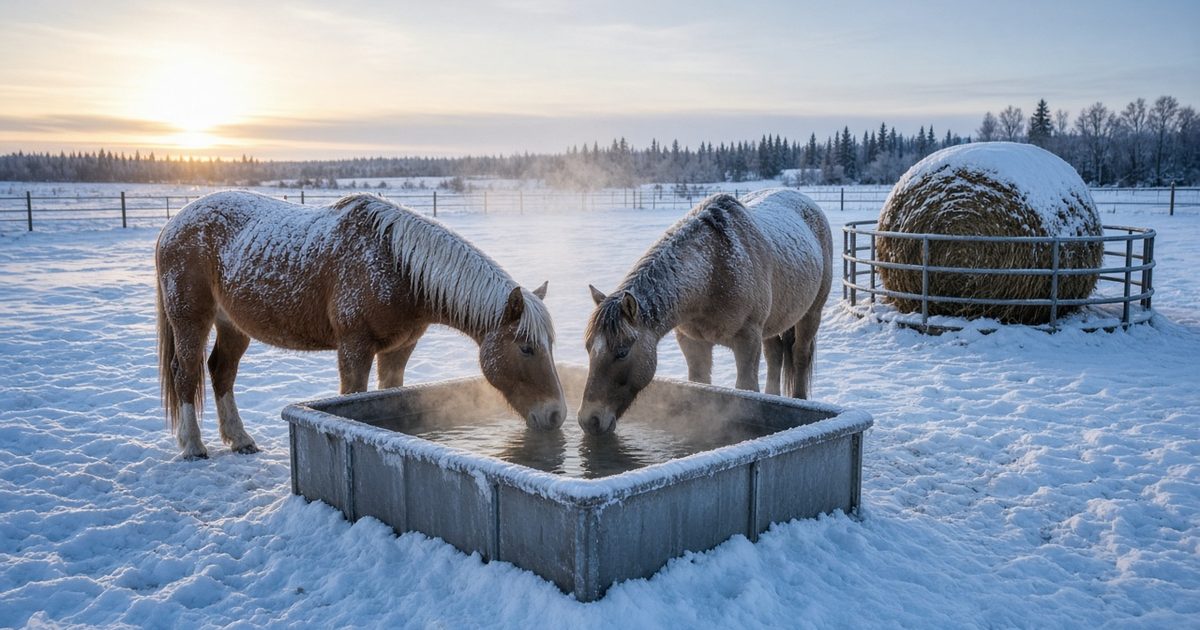
An Alberta winter asks two things of a feeding program that a mild autumn does not: unfrozen water, in a volume the horse will actually drink, and enough forage to make heat. Those two jobs are linked. University of Minnesota Extension (reviewed 2022) says that if a horse does not drink enough in cold weather it may eat less, have less energy to stay warm, and be more prone to impaction colic. Alberta Agriculture's Agdex 460/50-4 (reviewed August 2009) says the same in plainer language: horses tend to drink less when the weather turns cold, and less water plus a high-fibre diet can quickly lead to intestinal impaction.
The hay-increase math is covered in more detail in How Much Hay Does a Horse Eat a Day?. This article is about how water and feed work together in cold, wind, and snow, and how to use the horse feed calculator once you have a winter ration in mind.
Water: volume, temperature, and the snow question
Several official figures describe daily intake, and they are close without being identical:
- North Dakota State University Extension (Carrie Hammer, 29 January 2013): an average adult horse will drink 5 to 10 gallons of water per day.
- University of Minnesota, winter care (reviewed 2022): most 1,000-pound adult horses need at least 10 to 12 gallons daily.
- University of Minnesota, "Encouraging your horse to drink" (reviewed 2021): a 1,000-pound horse should drink about 8 to 10 gallons daily.
Dried winter feed, Minnesota's winter page says, contains less than 15 percent moisture, compared with lush pasture at 60 to 80 percent, so the horse must drink more, not less, when it is on hay. The goal is to maximize intake to help prevent dehydration and colic.
Water temperature matters. Minnesota recommends keeping water between 45°F and 65°F (about 7°C to 18°C). Research it cites found that ponies increased their water intake by approximately 40 percent each day when water temperatures were above freezing in cold weather. The same temperature band is repeated on Minnesota's drinking-encouragement page. Check tanks and automatic waterers so they do not freeze, inspect tank-heater wires, and test for stray voltage. See automatic waterers for the equipment side.
Do not rely on snow. Alberta's Agdex 460/50-4 is direct: although horses eat snow, they are not as efficient as cattle at getting the water they need from snow alone, and you should not rely on snow to provide your horse's water. Minnesota is similarly cautious: a few studies show that acclimated horses can meet requirements from snow, but serious risks remain because of adjustment time, the actual water content of snow, and total intake, including gastrointestinal complications, colic, and reduced feed intake. In an Alberta windchill, an open trough that is frozen at morning chores is not a water source.
Minnesota also recommends one to two ounces of salt daily for adult horses, and loose salt rather than a cold block that horses may not want to lick. Flavouring water or using electrolytes can help a fussy drinker, especially when travelling, but a separate plain-water source should always be available, and electrolytes without water can worsen dehydration.
Feed: forage makes heat, and the published cold thresholds differ
Forage fermentation produces more heat than grain digestion. That point appears in both the NDSU 2013 article and Minnesota's 2022 winter page, and it is why the first winter adjustment is usually more hay, not more grain. The daily starting point is still about 2 percent of body weight in feed for a typical mature horse (NDSU; Minnesota's idle 1,000-pound example is 20 pounds of hay). Then you add for cold, wind, wet, and waste. The companion hay article walks through those official percentages in detail.
Two extension sources give different lower critical temperatures. They should not be blended into one made-up number:
- NDSU (2013): for horses with a heavy winter coat, in dry, calm weather, the lower critical temperature is 30°F (−1°C). For each 10°F below that, horses need about 2 pounds more feed per day, assuming 1 megacalorie per pound (typical of most hay). A 10- to 15-mph wind adds 4 to 8 pounds of hay. A wet horse without shelter in wind may need an additional 10 to 14 pounds. A 1,000-pound horse on 20 pounds of hay in mild weather may not be able to eat an extra 10 to 20 pounds, in which case hay alone is usually insufficient and some grain is justified.
- Minnesota (reviewed 2022): the lower critical temperature estimate is 41°F with a summer coat and 18°F with a winter coat. For every degree below 18°F the horse requires about one percent more energy. Their worked example: if a 1,000-pound idle horse needs 16 pounds of good-quality hay at 18°F, the requirement may rise by about 2 to 2.5 pounds, to 18 to 18.5 pounds, if the temperature drops to 0°F, and more if there is no shelter.
Those thresholds are not the same. This article reports both and does not pick a "true" number the sources themselves do not reconcile. In an Alberta cold snap well below both 18°F and 30°F, the direction of travel is the same: more hay, then consider added calories if the horse cannot eat enough forage, and watch condition under the coat. Minnesota notes that a heavy coat can hide weight loss, and it recommends regular body condition scoring. Ohio State has treated a 6 as a reasonable winter target for some older horses, versus a usual ideal of 5; see the Henneke article.
Shelter changes what the horse can tolerate. Minnesota says that in the absence of wind and moisture, horses tolerate temperatures at or slightly below 0°F; with access to shelter they can tolerate temperatures as low as −40°F; and they are most comfortable between 18°F and 59°F, depending on hair coat. A 240-square-foot run-in (12 × 20 feet) is described as ideal for two horses, plus 60 square feet for each additional horse if they get along. Shelter use in their research ranged from under 10 percent in mild weather to 62 percent when it was snowing and wind exceeded 11 mph.
Alberta winters regularly combine cold, wind, and moisture — the conditions that make a coat less insulating. Minnesota notes that as little as 0.1 inch of rain can mat the hair and reduce its insulating value, and it lists blanketing as needed when there is no shelter and windchill drops below 5°F, when the horse may get wet, when the coat is clipped, when the horse is very young or very old or thin (BCS 3 or less), or when it is not acclimated. Do not blanket a wet horse. There is no Alberta blanketing law in the sources below; use condition, shelter, and weather.
Seniors and thin horses are at greater risk. Feeding the Senior Horse and Agdex 460/51-1 both note that older horses handle bad weather less well. Extra hay, unfrozen water, and shelter are the first tools, not a heavier blanket alone.
A practical Alberta winter checklist
- Provide clean, unfrozen water in the 45–65°F band Minnesota describes, and check it at least twice a day in a freeze. Do not count on snow.
- Start from a known body weight and a hands-on condition score, then set hay with the feed calculator.
- Add hay as the official cold-weather tables describe, using either NDSU or Minnesota consistently, and add a waste allowance that matches your feeder.
- Offer shelter from wind and wet. If you blanket, fit it, pull it daily, and keep it dry.
- Recheck condition every couple of weeks. If the horse is losing, increase forage first; if it cannot eat enough, involve your veterinarian or a nutritionist rather than dumping unlimited grain in a frozen paddock.
- Budget the extra hay against the October 2026 Alberta farm-gate average or, better, your invoices; see Alberta Hay Prices in 2026 and Small Square vs. Round Bales for Horses.
FAQ
How much water does a horse need in winter? Plan on the official adult ranges above: NDSU 5–10 gallons; Minnesota at least 10–12 gallons for many 1,000-pound horses, or about 8–10 gallons on the drinking-encouragement page. Offer more rather than less, at 45–65°F, and do not rely on snow.
Can horses eat snow instead of drinking? Alberta Agriculture says no, you should not rely on snow. Minnesota describes remaining health risks even in studies of acclimated horses.
How much extra hay does cold weather require? NDSU: about 2 pounds of typical hay for each 10°F below 30°F for a horse with a heavy coat in dry, calm weather, plus more for wind and wet. Minnesota: about one percent more energy for each degree below 18°F with a winter coat, and a worked example of an extra 2 to 2.5 pounds of hay when the temperature falls from 18°F to 0°F for a 1,000-pound idle horse on 16 pounds of hay.
Why do those two official thresholds differ? They come from different extension publications, with different coat and weather assumptions. This article reports both and does not invent a blended Alberta number.
Is grain better than hay for warmth? Both NDSU and Minnesota say forage fermentation produces more heat than grain digestion. Grain may still be needed when the horse cannot eat enough hay to meet a severe cold load.
Where do I run a winter ration? The horse feed calculator, after you have a weight and a condition score.
Sources
- North Dakota State University Extension, Carrie Hammer, "Feed Horses Properly in Winter" (29 January 2013). https://www.ag.ndsu.edu/news/newsreleases/2013/jan-28-2013/feed-horses-properly-in-winter
- University of Minnesota Extension, "Caring for your horse in the winter" (reviewed 2022). https://extension.umn.edu/agriculture/animals-and-livestock/horse/caring-for-your-horse-in-the-winter
- University of Minnesota Extension, Jennifer Johnson, DVM, "Encouraging your horse to drink" (reviewed 2021). https://extension.umn.edu/agriculture/animals-and-livestock/horse/encouraging-your-horse-to-drink
- Alberta Agriculture and Rural Development, Feeding and Management Considerations for Horses, Agdex 460/50-4 (reviewed August 2009). https://www1.agric.gov.ab.ca/$department/deptdocs.nsf/all/agdex9622/$FILE/feeding-and-management-considerations-horses.pdf
- Alberta Agriculture and Rural Development, Nutrition and Feeding Management for Horse Owners (Agdex 460/51-1, 2008). https://www1.agric.gov.ab.ca/$Department/deptdocs.nsf/all/agdex12189/$FILE/460_51-1.pdf
This article is general information, not veterinary advice. Talk to your veterinarian about your horse.