Barn Fire Prevention, Electrical Standards, and Evacuation Planning
By Mark Dunlop
Practical barn-fire prevention using official Alberta sources on electrical work, feed storage, and evacuation planning.
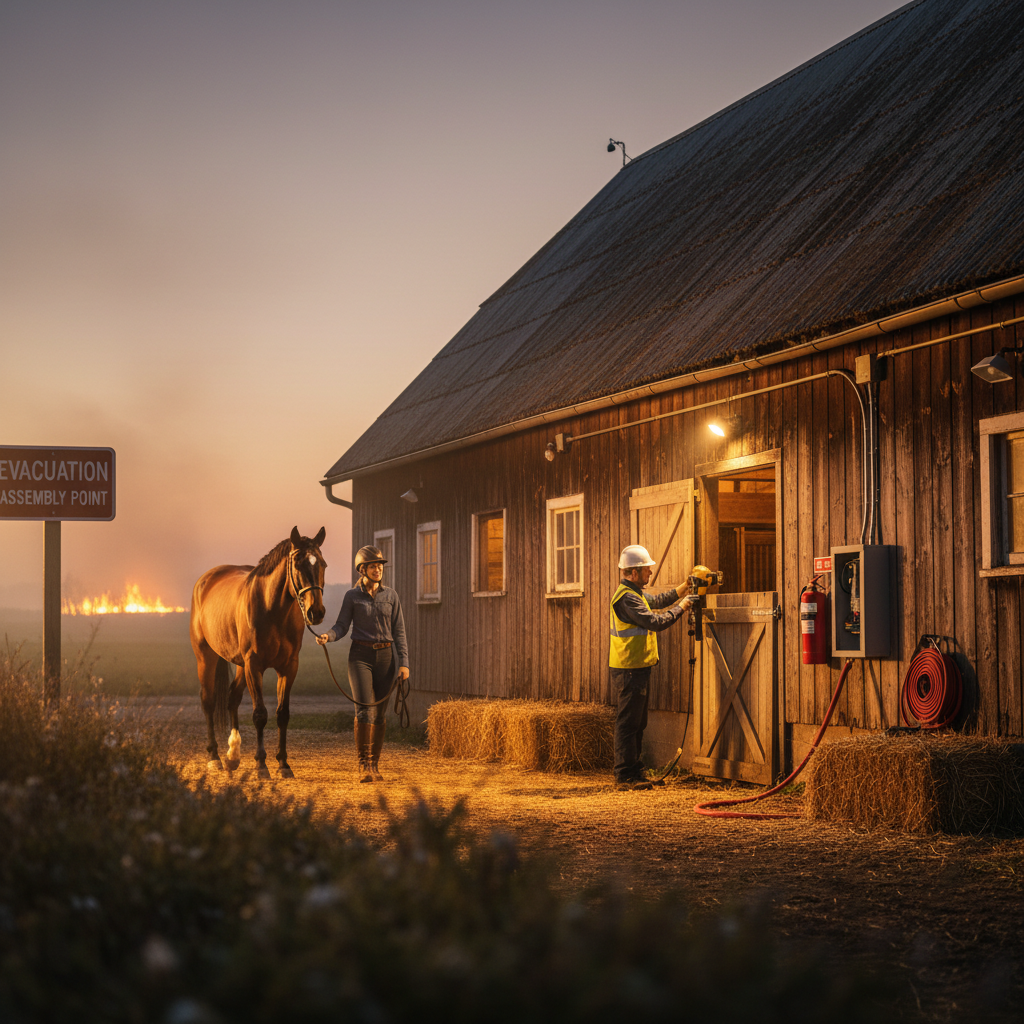
This article is educational. It is not a fire-code interpretation, an electrical design, or an emergency plan for your site. Use qualified electricians, the permits Alberta requires, and your local fire department's advice.
What official Alberta sources do say is enough to take fire seriously. Horse Handling Facilities (Agdex 460/722-1, revised 1985) tells readers to keep feed storage in the stable to a minimum to reduce fire risk; that large amounts of feed and dust increase the possibility of fire; that materials and designs should minimize risk and may aid in fire control; that vapour-proof (and usually dust-proof) light fixtures help reduce the fire hazard; that the fire risk is lower when feed is not stored in the stable; and that air circulation in a hay shed helps prevent heating and the danger of spontaneous combustion. It also notes that hay lofts are labour-heavy and that a separate hay shed is often the more practical building. Those are 1985 official statements, clearly dated, and they still describe the fuel load in a horse barn.
Electrical work is a code-and-permit job in Alberta
Do not treat a U.S. National Electrical Code article as if it were the law in Alberta. Alberta uses the Safety Codes Act and the Canadian Electrical Code, as administered locally.
The Government of Alberta's permits page states that building, electrical, gas, plumbing, and related projects that fall under the Safety Codes Act must meet provincial requirements, that the owner is responsible for compliance, that appropriate permits are required, and that you can expect inspection by a trained safety codes officer.
A February 2014 Alberta Electrical Safety information bulletin (CEC-22, rev-4) discusses Canadian Electrical Code Rule 22-204, wiring methods in buildings housing livestock and poultry, including when certain damp-location wiring may be used if ventilation is adequate, and notes that "adequate" can be a question for a Safety Codes Officer, who may ask for evidence. This article will not decide that question for your barn, and it does not set a 2026 inspection price.
Box fans, heated buckets, tank heaters, and extension cords are common winter fire and shock risks. The automatic waterers article and the 1985 Agdex fact sheet both stress that electrically heated waterers must be properly grounded. Have a qualified electrician inspect heaters, cords, and dusty fan motors. Unplug what you do not need. Do not run a household extension cord through bedding as a permanent circuit.
If you budget electricity, the October 2026 farm-input survey lists farm-use electricity, excluding service or delivery, at $11.93 per 100 kWh. That is a unit price, not a barn-fire budget. Facility repairs more broadly sit in Equestrian Canada 2022 Table 6 (Alberta recreation facility repair $1,045 per equine per year) — a survey average, not a sprinkler bid. The barn profit calculator is the place for a current line item.
Hay, dust, and a separate storage building
The 1985 fact sheet's advice to keep feed out of the stable, to use a hay shed with air circulation, and to reduce dust is the core prevention message. Spontaneous heating in damp hay is a real risk. If hay feels hot or smells wrong, treat it as a veterinary-and-fire problem rather than relying on a generic moisture target. Store hay so you can walk around it, and keep lights and wiring cleaner than a hayloft usually is.
A defensible space around the barn — cleared grass, a place for a fire truck to turn, and a clearly marked water source if you have one — is a conversation to have with your local fire department. The sources below do not set a fire-code setback in metres. Agdex 460/722-1 does recommend siting barns and corrals some distance (it says 100 m) from the residence, with room for trucks and trailers; that is site-planning advice from 1985, not a fire-code setback.
Evacuation, without invented times
Horses may not walk out of a stall they think of as safe. An evacuation plan should be written, posted, and practiced when there is no smoke: how doors swing, who opens which stalls, where the horses go, and how you reach the fire department. Keep halters or a way to move horses where you can find them in the dark. Talk to your fire department before a fire, including how they will find the property and whether they have a plan for livestock calls.
This article will not tell you to leave a horse that will not exit, or to go back into a burning aisle. Those are life-safety decisions for the people on the ground. Residential smoke detectors are often a poor fit for a dusty, damp barn; ask your fire department or a qualified installer what detection they will support in an agricultural building. Sprinklers are a capital project for a designer and the authority having jurisdiction, not a blog cost-per-square-foot.
Keep extinguishers where people can reach them, and have them inspected on the schedule your provider or fire department recommends — the official sources fetched here do not set that interval. First-aid and a contact list for veterinarians belong next to the halters.
FAQ
Can residential smoke detectors work in a horse barn? Often they are the wrong tool for dust and moisture. Ask your fire department or a qualified installer. This article does not name a barn-rated brand.
Should I install a sprinkler system? That is a design and code question for professionals, not a yes from a blog, and not at a generic per-square-foot price.
What if a horse will not leave a stall? Have a plan, and do not make the people more valuable than they already are by going back into a burning building. Discuss livestock evacuation with your fire department in advance.
How often should extinguishers be inspected? Follow the inspector or fire department. The sources below do not set a monthly or annual inspection interval.
Sources
- Alberta Agriculture, Horse Handling Facilities, Agdex 460/722-1 (revised 1985). https://open.alberta.ca/dataset/808ca330-589e-4fad-95b2-0dfac083c314/resource/4b98390c-5140-4ba3-9624-9821d7faa974/download/163010276893-horse-handling-facilities.pdf
- Government of Alberta, "Permits and Alberta's safety code system." https://www.alberta.ca/permits-and-albertas-safety-code-system
- Alberta Municipal Affairs, Electrical Safety Information Bulletin, February 2014, CEC-22 [rev-4]. https://open.alberta.ca/dataset/7887ccca-d84e-4156-8e32-8f3ebd3ed66d/resource/4314eb23-ec86-45b1-bb3b-80abefc6acc8/download/460-cec-22-rev4.pdf
- Alberta Agriculture and Irrigation, Alberta Farm Input Prices, October 2026 (published 5 November 2026).
- Equestrian Canada, Socio-Economic Impact Assessment, Table 6 (2022). https://equestrian.ca/wp-content/uploads/2024/05/EC-Impact-Assessment-Supplementary-Information.pdf
This article is general information, not veterinary advice. Talk to your veterinarian about your horse.