Equine Cushing's (PPID): Testing, Costs & Management Protocols
By Claire Halden
Equine Cushing's Disease (PPID) affects up to 30% of senior horses. Learn current diagnostic protocols, real-world Prascend costs, and targeted feeding strategies.
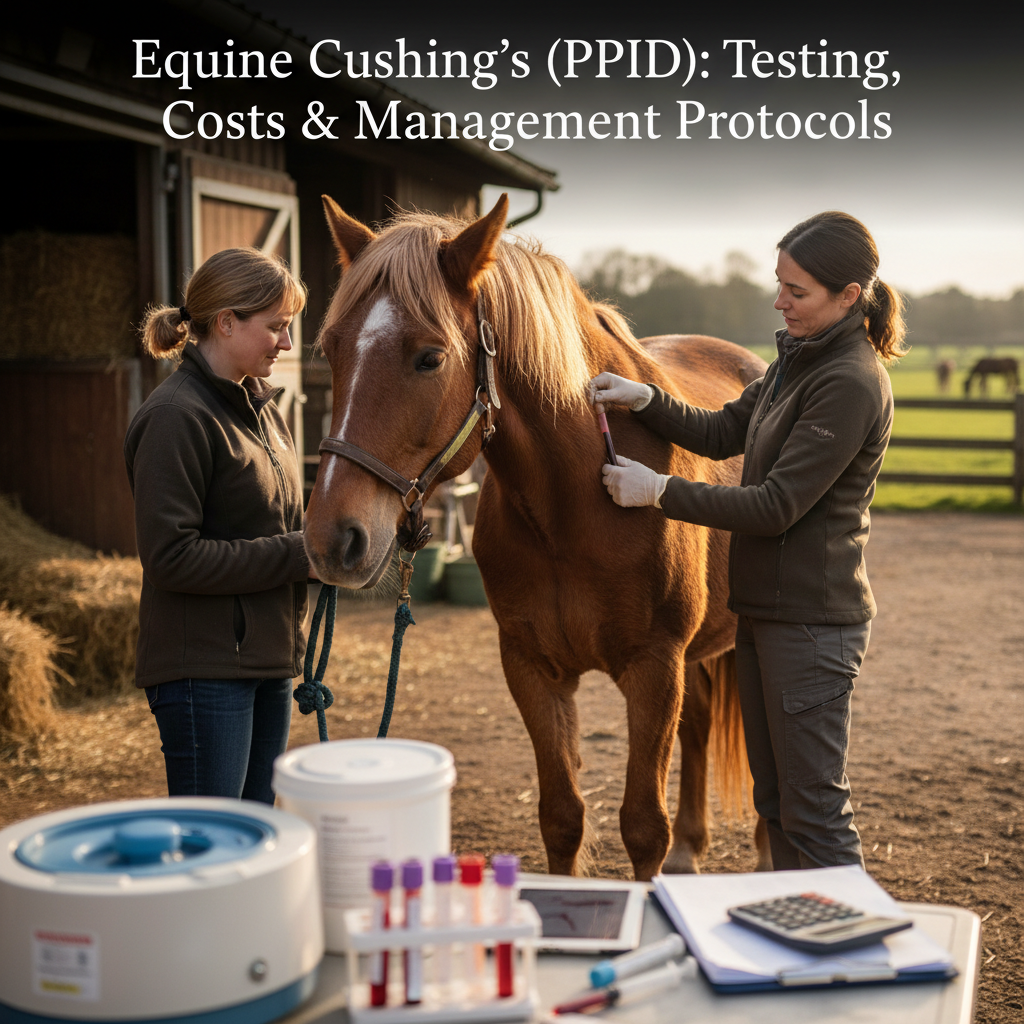
Roughly 20% to 30% of horses over the age of fifteen suffer from Pituitary Pars Intermedia Dysfunction (PPID), commonly known as Equine Cushing's Disease. What begins as subtle lethargy, a delayed spring shed, or recurring foot soreness can quietly progress into life-threatening laminitis if left unmanaged.
PPID is not a death sentence, nor is it a malignant tumor. It is a slow, progressive neurodegenerative disorder of the endocrine system. Managing a horse with Cushing’s requires objective diagnostic testing, careful pharmaceutical titration, and disciplined nutritional control.
Here is what horse owners, barn managers, and trainers need to know about testing protocols, the real-world economics of pergolide therapy, and day-to-day management.
Pathophysiology: What Happens in the PPID Brain?
In a healthy horse, hypothalamic dopaminergic neurons send dopamine to the pars intermedia (the intermediate lobe of the pituitary gland). Dopamine acts as an inhibitory brake, controlling the production of pro-opiomelanocortin (POMC) peptides, including adrenocorticotropic hormone (ACTH).
In PPID horses, these dopaminergic neurons degrade over time due to oxidative stress. Without the dopamine brake, the melanotropes in the pars intermedia undergo hyperplasia and hypertrophy, churning out excessive amounts of ACTH, alpha-melanocyte-stimulating hormone ($\alpha$-MSH), beta-endorphin, and CLIP (corticotropin-like intermediate peptide).
Elevated circulating ACTH prompts the adrenal glands to release excess corticosteroids into the bloodstream, triggering the classic systemic signs:
- Muscle wasting (particularly epaxial muscles along the topline)
- Regional adiposity (fat deposits above the eyes and across the crest)
- Hypertrichosis (long, curly hair coat that fails to shed)
- Secondary immunosuppression leading to chronic sinusitis, non-healing skin infections, and sole abscesses
- Polyuria and polydipsia (excessive urination and drinking)
Diagnostic Testing: When and How to Test
Diagnosing PPID accurately requires understanding seasonal physiology. The Equine Endocrinology Group (EEG) updates guidelines regularly, providing clear protocols for veterinary diagnostics.
1. Resting Baseline Plasma ACTH
This is the most common first-line screening test. A veterinarian draws whole blood into a chilled EDTA tube, spins it down, and freezes the plasma within hours for laboratory submission.
- Non-Autumn Testing (January to mid-July): Normal baseline ACTH is typically below 30–35 pg/mL. Levels above 40–50 pg/mL strongly indicate PPID.
- The Autumn Seasonal Rise (Mid-July to mid-November): All horses experience a natural spike in pituitary hormone output as day length decreases. Normal horses may test up to 100 pg/mL, while PPID horses often surge past 200–500+ pg/mL.
- Note: Laboratories such as Cornell University’s Animal Health Diagnostic Center (AHDC) publish seasonally adjusted reference intervals. Always ensure your veterinarian interprets values against season-specific baselines.
2. TRH Stimulation Test
When a horse shows early clinical signs but baseline resting ACTH falls in a borderline "gray zone," the Thyrotropin-Releasing Hormone (TRH) Stimulation Test is the gold standard for early detection.
- The Protocol: The veterinarian takes a baseline blood sample, administers 0.5 mg to 1.0 mg of intravenous TRH, and collects a second sample exactly 10 minutes later.
- Interpretation: In non-autumn months, an ACTH concentration greater than 110 pg/mL at the 10-minute mark confirms PPID.
- Caveat: The EEG recommends avoiding TRH stimulation testing during the peak autumn rise (September and October) due to high false-positive rates caused by extreme seasonal variability.
Pergolide Mesylate: Protocols, Brands, and Realistic Costs
The only FDA-approved medical treatment for PPID is pergolide mesylate, a potent dopamine receptor agonist that chemically replaces the missing inhibitory neurotransmitter.
Prascend vs. Compounded Pergolide
Boehringer Ingelheim’s Prascend is the proprietary, FDA-approved, pink scored tablet (1 mg). While compounded liquid or powdered pergolide was common in past decades, studies highlighted by the American Association of Equine Practitioners (AAEP) show that compounded formulations degrade quickly in light and moisture, frequently delivering inconsistent dosages.
Under federal compounding rules, Prascend remains the legal and clinical standard of care in the United States unless an individual horse cannot consume tablets.
+--------------------------+-----------------------+------------------------+
| Product / Option         | Typical Daily Dose    | Estimated Monthly Cost |
+--------------------------+-----------------------+------------------------+
| Prascend (1 mg tablet)   | 0.5 mg – 1.0 mg/day   | $75 – $110 / month     |
| Prascend (High Dose)     | 2.0 mg – 3.0 mg/day   | $150 – $320 / month    |
| Compounded Pergolide*    | Equivalent strength   | $45 – $75 / month      |
+--------------------------+-----------------------+------------------------+
*Subject to stability issues; consult your veterinarian regarding compounding legality.
Initial Dosing and Managing the "Pergolide Veil"
Standard starting doses range from 0.5 mg to 1.0 mg per 1,000 lbs of body weight once daily.
Some horses experience a temporary side effect known as the "pergolide veil"—a brief period of anorexia, dullness, or lethargy lasting 3 to 10 days after starting treatment. To mitigate this:
- Step-dose: Start at 0.25 mg or 0.5 mg for the first 5–7 days before stepping up to the target 1.0 mg dose.
- Add APF (Adaptogenic Post-Formulation): Many clinicians recommend concurrent administration of adaptogenic herb supplements during initiation to restore appetite.
- Hide the pill effectively: Use a hollowed-out carrot slice, a piece of apple, or a commercial pill-hiding paste. Avoid dissolving Prascend in warm mashes hours in advance, as exposure to light and water degrades the active compound.
Monitoring Efficacy
Recheck resting ACTH levels 30 to 60 days after starting therapy or after any dose adjustment. Once the horse stabilizes clinically and biochemically, test twice annually: once in the spring to confirm baseline control, and once in early autumn to catch any unmanaged seasonal breakthrough.
Nutritional Management for PPID Horses
A common misconception is that PPID is identical to Equine Metabolic Syndrome (EMS). While distinct, PPID and EMS frequently overlap. Up to one-third of horses with PPID also suffer from concurrent insulin dysregulation (ID), placing them at immediate risk for endocrinopathic laminitis.
       +-----------------------+      +-----------------------+
       |         PPID          |      |          EMS          |
       |  (Pituitary Disease)  |      |  (Metabolic Disorder) |
       +-----------+-----------+      +-----------+-----------+
                   \                             /
                    \                           /
                     +-------------------------+
                     |    Overlapping Zone:    |
                     |  Insulin Dysregulation  |
                     |   & Laminitis Risk      |
                     +-------------------------+
1. Carbohydrate Control (NSC < 10%)
Non-structural carbohydrates (NSC = starch + water-soluble carbohydrates/WSC) must be restricted to under 10% to 12% of dry matter intake for any PPID horse with elevated insulin or past laminitis history:
- Test your forage: Send core samples of your hay to a certified lab (e.g., Equi-Analytical). Calculate your forage allocations and overall dietary percentages using our Horse Feed Calculator to ensure you maintain safe caloric and protein balance.
- Soak hay when needed: Soaking hay in warm water for 30 minutes (or cold water for 60 minutes) leaches out water-soluble sugars, dropping the NSC by up to 30%.
- Track hay expenses: High-quality, low-sugar grass hay often commands a regional premium. Budgeting bulk loads accurately with the Hay Bale Cost Calculator helps barn owners manage the financial shift toward tested low-NSC forage.
2. Protein and Amino Acid Support
Cushing’s horses burn through muscle protein due to persistent catabolic hormone exposure. They often present with a swaybacked, potbellied appearance despite having normal body fat stores.
- Supplement high-quality protein containing limiting amino acids: L-lysine (10–20 g/day), DL-methionine (5–10 g/day), and L-threonine.
- A concentrated ration balancer (1 to 2 lbs per day) is far superior to standard sweet feeds or plain oats, providing essential trace minerals (copper, zinc, selenium) without dangerous starch spikes.
3. Body Condition Adjustments
Use the Horse Weight Calculator regularly alongside monthly weight-tape measurements. A PPID horse that appears thin may simply have severe muscle atrophy; feeding excess calories to an insulin-resistant horse with muscle wasting can trigger laminitis rather than building real topline.
Daily Management and Husbandry Protocols
Pharmaceuticals handle the pituitary gland, but day-to-day husbandry determines whether a PPID horse thrives.
- Body Clipping: Overgrown coats trap heat and sweat, creating ideal conditions for fungal dermatitis (rain rot) and external parasites. Plan to body-clip PPID horses in late spring and repeat in mid-summer if shedding fails. Provide appropriate turnout blankets in winter if the natural coat has been clipped away.
- Strict Farriery Intervals: Lamellar tissue integrity can decline subtly even without acute laminitic episodes. Maintain a consistent 4-to-6-week trim cycle to minimize toe leverage and support heel structure.
- Aggressive Parasite and Dental Control: Immune suppression allows internal parasite burdens to rise. Perform fecal egg counts (FEC) twice a year rather than relying on calendar-based deworming. Schedule dental exams every 6 months to address loose teeth, diastemata, and periodontal disease common in geriatric PPID equines.
Frequently Asked Questions
Can PPID be cured or prevented?
No. PPID is a progressive, irreversible neurodegenerative condition. It cannot be cured, nor is there currently an established method to prevent the age-related breakdown of dopaminergic neurons. However, early detection and lifelong daily pergolide administration can normalize hormone levels and provide years of comfortable, active life.
Is chasteberry (Vitex agnus-castus) an effective substitute for Prascend?
Clinical trials conducted by veterinary universities, including research published in The Horse magazine and the Equine Veterinary Journal, demonstrate that chasteberry does not lower plasma ACTH concentrations or arrest pituitary tumor progression. While it may occasionally improve shedding behavior in mild cases, it lacks the dopaminergic potency needed to prevent laminitis. It should not replace pharmaceutical pergolide.
How do I know if my PPID horse is developing laminitis?
Watch for subtle early indicators: reluctance to turn in tight circles, shifting weight back and forth between front feet, increased digital pulse strength, and warm hooves. If your horse spends more time lying down or walks gingerly on hard ground, contact your veterinarian immediately for baseline digital radiographs and insulin checks.
Should I fast my horse before drawing blood for an ACTH test?
No. Fasting can induce stress, which artificially spikes ACTH levels. EEG guidelines recommend feeding a standard meal of low-NSC grass hay prior to testing. Simply withhold high-grain concentrates, sweet feeds, or pasture turn-out for 2 to 4 hours before the blood draw.
This article is general information, not veterinary advice. Talk to your veterinarian about your horse.