How to Body Condition Score a Horse (Henneke 1–9 Scale)
By Claire Halden
Learn the Henneke 1–9 body condition score, how it differs from a 1–5 scale, and how to use a condition-score calculator with a weight estimate.
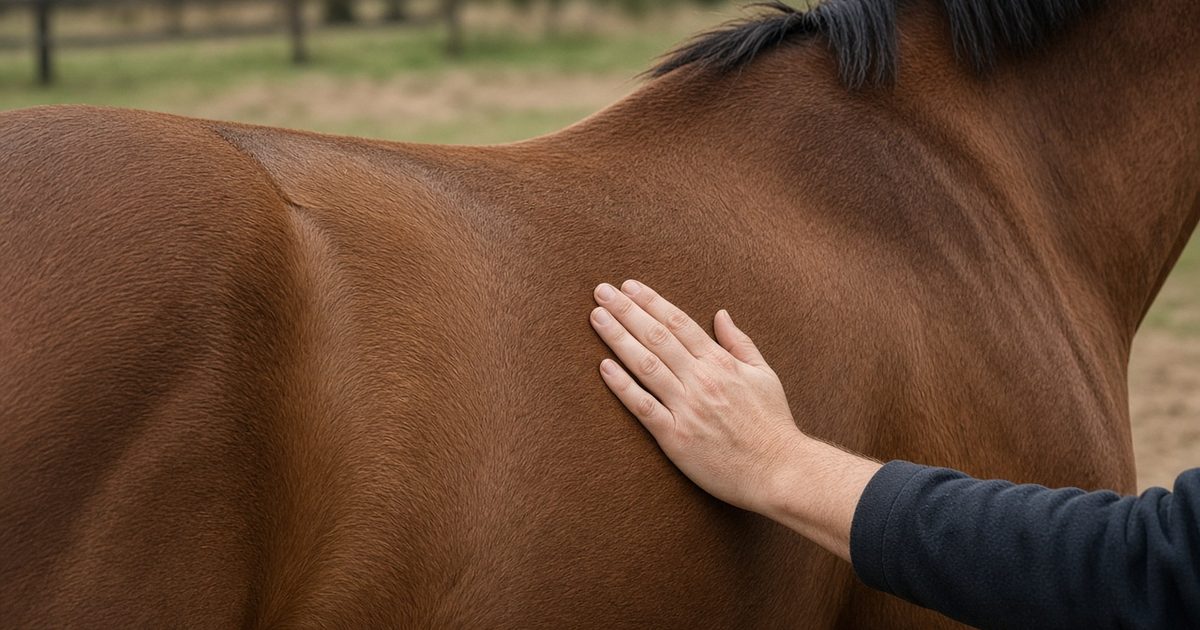
This article is educational and is not a veterinary diagnosis. A body condition score does not replace a veterinary exam, especially if a horse is losing weight, gaining rapidly, or showing signs of metabolic disease.
A scale weight, or a carefully taken tape estimate, tells you how heavy the horse is. A body condition score (BCS) tells you how much of that weight is fat. Ohio State University Extension's fact sheet Evaluating body composition of horses (AS-1024, 27 June 2022) explains the difference: condition scoring measures fat cover and storage, not muscling, and conformation differences between breeds should not change the score when all of the criteria are applied.
The system most often used in the United States, and the one this article walks through, is the Henneke 1-to-9 scale, published by Henneke, Potter, Kreider, and Yeates in the Equine Veterinary Journal in 1983. Ohio State notes that in other countries, and in other species, 1-to-5 scales are common. Ontario's weight-estimation factsheet uses a nomogram that refers to a condition score of 3 on its chart for a 14-hand pony example — a reminder that a "3" on a 1–5 scale is not a "3" on Henneke's 1–9 scale. Say which scale you are using, every time.
The Equine Tools Hub condition-score calculator is a place to record a score beside a weight estimate. For the weight itself, see How to Calculate Horse Weight with a Weight Tape and the companion article on tapes and formulas.
The six areas, and how to score them
Ohio State, adapting Henneke, describes six areas: the neck, withers, behind the shoulder, ribs, loin/back, and tailhead. Score each area, including by touch — long winter hair will hide fat — then average the scores. Half-point increments are allowed. There is no single "best" place to start, but a consistent front-to-back approach keeps you from skipping a spot.
Extension Horses, in Assessing the Health and Well-being of Horses, summarizes the 1–9 bands this way:
- 1–3: very poor to thin. Bones visible, little or no palpable fatty tissue. These horses are not considered healthy.
- 4–6: described as the normal, healthy band. A 4 still shows ribs with a vertebral ridge evident; a 5 has a flat back, ribs that cannot be seen but can be felt; a 6 may show a crease down the back and some fat deposits.
- 7–9: fleshy to extremely fat, with deposits at the flank, tailhead, withers, over the ribs, behind the shoulders, and along the neck. These horses are too fat and are described as more prone to metabolic disease such as laminitis, and to muscle problems.
Ohio State uses 5 as the usual "ideal" in the Henneke system, while noting that some management situations prefer something slightly different: a Thoroughbred in heavy race training may reasonably sit at a 4, and a retired geriatric horse heading into winter may be better at a 6. Extension Horses' cost-saving page calls 5.0–5.5 ideal on the 1–9 scale, and says that keeping a horse at 4 or less, or 7 or greater, can be dangerous and expensive. For broodmares, Extension Horses' fall-management page says mares with a BCS of 5.5 to 7.5 foal without problems and are easier to get in foal than thin mares at 4 or below, and that there is no reason for broodmares to sit at 8 or 9.
Those targets do not contradict each other if you keep the horse's job in view. A recreational Alberta gelding heading into January is not a racehorse, and a late-pregnant mare is not an easy keeper on spring grass.
How to do it in the barn aisle
- Stand the horse square on level ground, if you can, with the head in a normal position.
- Look, then put your hands on all six areas. Palpation matters more in a winter coat.
- Do not confuse a "hay belly" with fat. Extension Horses' broodmare-condition page warns that horses on a high-forage diet can have a lower, distended abdomen that causes people to overestimate condition.
- Do not let a thick neck in a stallion, or a cresty neck, stand in for a whole-body score. Ohio State treats cresty neck scoring (0–5, Carter et al. 2009) as a separate fat-distribution tool; a cresty-neck score of 3 or greater is flagged as a metabolic-risk marker in the research it cites, especially in ponies.
- Write the score down with the date, the scale (Henneke 1–9), and a weight estimate. A single score is less useful than a short series.
- If the score and the weight disagree with what you expected, look at teeth, parasites, work, and the hay analysis before you simply add grain. See How Much Hay Does a Horse Eat a Day? and Feeding the Senior Horse if the horse is older.
Ohio State notes that, in the research it cites, most of the domestic horse population is overweight or obese, and that owners often underestimate fat. Those studies are not a Canadian census. The practical lesson still holds on an Alberta yard: feel for fat under the winter coat, and do not let a rugged hair coat hide a 7.
What a score cannot do
It cannot age a horse, diagnose PPID or equine metabolic syndrome, or replace a scale when you are dosing a drug. It can tell you whether last month's ration is moving fat in the right direction. For broodmares in late gestation, Extension Horses says the weight of the fetus can reduce fat cover over the ribs, so other areas should carry more of the score. For seniors, muscle loss along the topline is not the same as fat loss; Ohio State discusses muscling separately from BCS. The existing Equine Tools Hub article on Equine Cushing's (PPID) is the companion read if an older horse is losing muscle, drinking more, or growing a long coat.
FAQ
What is a good Henneke score? Ohio State treats 5 as the usual ideal, with some jobs reasonably at 4 and some older horses heading into winter reasonably at 6. Extension Horses often cites 5.0–5.5 for a general ideal, and 5.5–7.5 for broodmares at foaling. Scores of 4 or below, or 7 and above, are the bands those sources flag as risky for a typical riding horse.
Is a score of 3 "moderate"? Not on the Henneke 1–9 scale. A 3 is thin. A 3 on a 1–5 scale, which Ontario and some other countries use, is a different system. Always name the scale.
Can I score a horse in a winter coat? Yes, if you use your hands. Visual appraisal alone is unreliable when the coat is long. Ohio State emphasizes touch as well as sight.
How often should I score? The sources above do not fix a single official interval. Score at every ration change, at the start and end of the grazing season, and whenever the horse looks different. A monthly note through an Alberta winter is a reasonable barn habit.
Does body condition replace a weight tape? No. Use both. Weight is for dosing and ration math; condition is for fat cover. The condition-score tool and the weight calculator are meant to be used together.
My horse is a 5 but looks ribby from one side. Score all six areas and both sides. Asymmetry can be fat, muscle, or an underlying issue worth a veterinary look.
Sources
- Ohio State University Extension, Sara L. Mastellar, Elizabeth Share, and Haley M. Zynda, "Evaluating body composition of horses," AS-1024 (27 June 2022). https://cfaes.osu.edu/fact-sheet/evaluating-body-composition-horses
- Henneke, D.R., G.D. Potter, J.L. Kreider, and B.F. Yeates (1983), "Relationship between condition score, physical measurements and body fat percentage in mares," Equine Veterinary Journal 15: 371–372.
- Extension Horses, "Assessing the Health and Well-being of Horses." https://horses.extension.org/assessing-the-health-and-well-being-of-horses/
- Extension Horses, "Body Condition and Reproductive Performance of Broodmares." https://horses.extension.org/body-condition-and-reproductive-performance-of-broodmares/
- Extension Horses, "Cost Saving Tips for Equine Operations" (ideal BCS 5.0–5.5). https://horses.extension.org/cost-saving-tips-for-equine-operations/
- Extension Horses, "Broodmare Management in Fall." https://horses.extension.org/broodmare-management-in-fall/
- Ontario Ministry of Agriculture, Food and Agribusiness, "Estimating body weight for horses" (includes a condition-score-and-height nomogram on a different scale). https://www.ontario.ca/page/estimating-body-weight-horses
This article is general information, not veterinary advice. Talk to your veterinarian about your horse.