How to Calculate Horse Weight with a Weight Tape (and When a Formula Is Better)
By Claire Halden
Learn how to estimate a horse's weight with a weight tape or girth-and-length formula, using Ontario and extension methods, plus a free calculator.
This article is educational and is not a substitute for veterinary care or a personalized nutrition plan. Use a scale whenever you can for medications, and ask your veterinarian before dosing.
Knowing your horse's weight is not a vanity number. Ontario's Ministry of Agriculture, Food and Agribusiness (OMAFRA) notes that weight is a basic health indicator, and that dewormer and antibiotic doses are calculated from it. Over-dosing, the ministry says, may cause toxicity, colic, or other serious complications, including death. Under-dosing will not produce the desired effect and, for antibiotics, may contribute to resistance. Feed amounts are also built on body weight. Alberta Agriculture's Nutrition and Feeding Management for Horse Owners uses body-weight percentages as the starting point for how much forage a mature, idle horse should eat. If the weight is wrong, the hay ration is wrong too. A scale is still the gold standard. When you cannot walk the horse onto one, a weight tape or a girth-and-length formula is the practical next step.
You can run the numbers on the Equine Tools Hub horse weight calculator after you take the measurements described below.
Why eyeballing is a poor substitute
Extension Horses, a national Cooperative Extension site, reports a study of 77 farm managers and 62 veterinarians (averaging 17 and 21 years of professional experience with horses). Asked to estimate the weight of five horses of varying sizes, they failed to produce a reasonable visual estimate nearly 100 percent of the time. They guessed low 87.5 percent of the time, by an average of 186 pounds, and high 12.5 percent of the time, by an average of 92 pounds. Nearly 60 percent underestimated all five horses. Experience does not make a glance as good as a measurement.
How to use a heart-girth weight tape
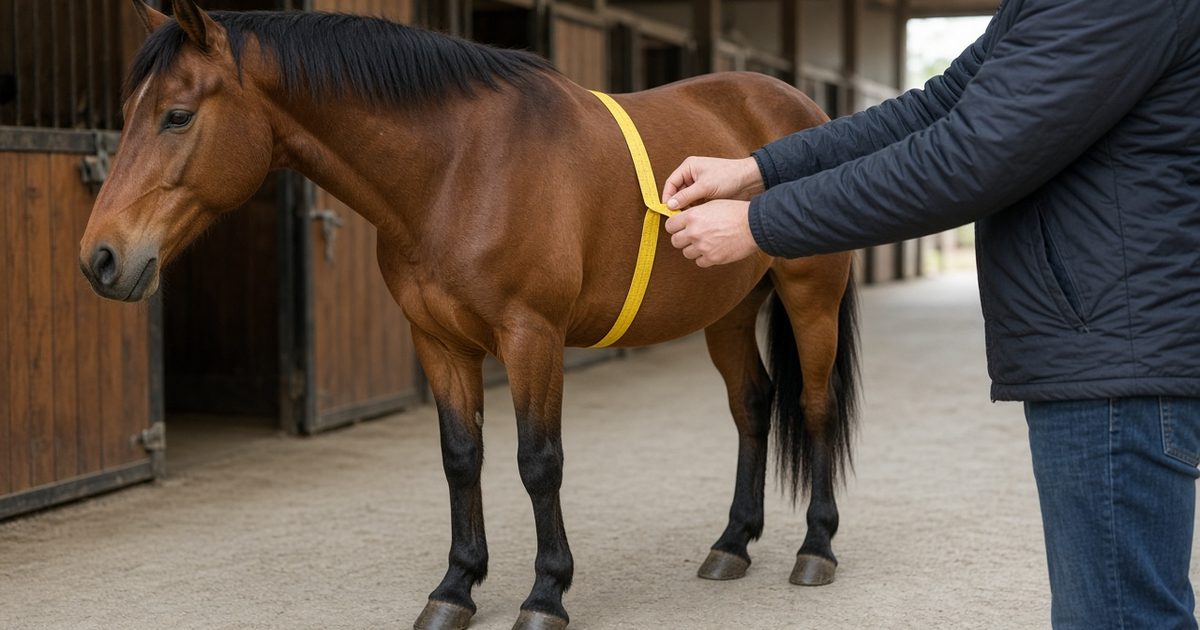
A commercial weight tape is sold at most feed and tack shops. OMAFRA describes the method this way: wrap the tape around the girth, directly behind the elbow, overlap the ends, keep the tape snug, and take the reading after the horse has exhaled. Extension Horses describes the same idea as wrapping the tape snugly around the barrel, approximately over the heart girth, and reading the weight marked on the tape.
Ohio State University Extension advises using the tape according to its printed directions and staying consistent, because brands can vary slightly, and always using the same spot on the withers to track change. From unpublished data, Ohio State reports that tapes usually read lighter than a scale, though this varies from horse to horse. Extension Horses is more blunt: expect a tape to be "off" by as much as 100 pounds in either direction. The same page says heart-girth tapes are completely useless for pregnant mares, foals, and miniature horses, and nearly useless for very fit racehorses. OMAFRA likewise says tapes are not effective on minis and foals, and that accuracy depends on the user, withers size, breed, and age. The University of Arkansas Division of Agriculture adds that the method may not be highly accurate for pregnant mares or horses with extreme conformational irregularities.
A tape is still a useful barn tool for an adult horse of ordinary shape, especially if you repeat the same method. It is not a substitute for a scale when the dose has a narrow margin, and it is the wrong tool for foals, minis, and late-pregnant mares.
The girth-only chart, if you do not have a marked tape
If you have a sewing or livestock measuring tape but not a commercial "weight tape," OMAFRA and Extension Horses both reprint a girth-only chart taken from Lon Lewis's Feeding and Care of the Horse. Selected rows:
- 64.5 inches (164 cm) girth — 800 lb (364 kg)
- 67.5 inches (171 cm) — 900 lb (409 kg)
- 70.5 inches (178 cm) — 1,000 lb (455 kg)
- 73.0 inches (185 cm) — 1,100 lb (500 kg)
- 75.5 inches (192 cm) — 1,200 lb (545 kg in the OMAFRA table; Extension Horses lists 454 kg in that row, which does not match 1,200 lb, so use the OMAFRA figures or, better, a two-measurement formula)
A girth-only chart is a backup, not a more accurate method than girth plus length.
The more accurate method: girth plus body length
Extension Horses, citing Carroll and Huntington (1988) in the Equine Veterinary Journal, reports that girth measurement alone had a correlation of 0.87 with body weight, while girth and length together had a correlation of 0.90. That two-measurement method is the one OMAFRA recommends when you want a slightly more accurate estimate than a tape, and the one it says should be used for racehorses in full work.
How to measure
Both OMAFRA and Extension Horses use the same landmarks, based on Carroll and Huntington:
- Heart girth: immediately behind the elbow, after the horse has breathed out.
- Body length: from the point of the shoulder to the point of the buttocks.
The University of Arkansas notes that the horse should stand somewhat square, and that body length is easier to take accurately with a helper. If you are tracking weight over time, measure at the same time of day; Arkansas recommends morning, before feeding. OMAFRA says that if you use a scale, weigh the horse under the same conditions — for example, two hours after it has been fed and watered — so fluctuations do not look like real change. Use the same consistency with a tape or formula.
Two official formulas (they are close, but not identical)
Canadian owners should know that published formulas differ by a small constant.
OMAFRA (Ontario), for adult horses, measurements in centimetres, result in kilograms:
Weight (kg) = (girth in cm × girth in cm × length in cm) ÷ 11,900
Extension Horses, citing Carroll and Huntington (1988), also in centimetres and kilograms, uses 11,880 in the denominator rather than 11,900.
Ohio State University and the University of Arkansas, measurements in inches, result in pounds:
Weight (lb) = (heart girth in inches × heart girth in inches × body length in inches) ÷ 330
OMAFRA and Extension Horses both walk through the same published example on a nomogram: a horse with a girth of 180 cm and a length of 175 cm shows an estimated body weight of 475 kg. That is the official worked example. If you prefer to do the arithmetic yourself with Ontario's 11,900 constant: 180 × 180 × 175 = 5,670,000, and 5,670,000 ÷ 11,900 ≈ 476 kg, which rounds to the 475 kg shown on the chart.
Here is a second, clearly labeled illustration using the inch formula, not a weighed horse. If the heart girth is 70 inches and the body length is 68 inches: 70 × 70 × 68 = 333,200, and 333,200 ÷ 330 = 1,010 lb (rounded from 1,009.7). Put the same measurements into the horse weight calculator to confirm your arithmetic.
Do not average a tape reading and a formula reading. Pick one method, write down the date, the measurements, and the result, and repeat it the same way next month.
Foals are a different equation
OMAFRA and Extension Horses publish a separate estimate for foals from birth to 60 days:
Weight (kg) = (heart girth in inches − 25) ÷ 0.07
Extension Horses adds that the average Thoroughbred or Standardbred foal will double its weight in the first 28 days. Because tapes are not considered effective on foals, this formula — or, better, a scale — is the route to use for a youngster. Ask your veterinarian how they want weights taken before you dose a foal.
What a number cannot tell you
Weight is not the same as condition. Ohio State University's body-composition fact sheet explains that body condition scoring (the Henneke 1-to-9 scale in the United States, with 1-to-5 scales common in other countries) measures fat cover, not muscling. A fit horse and an overweight horse can share a scale weight and still need different feeding plans. Ohio State also notes that, in the research it cites, most of the domestic horse population is overweight or obese, and that owners often underestimate fat. Those studies are not a Canadian census, but the barn advice still holds in Alberta: feel for fat cover under the winter coat, and do not let a single tape number replace a body condition score and, when something looks off, a veterinary exam.
OMAFRA lists health problems, parasites, dental disease, overwork, an unbalanced or insufficient diet (including from a low place in the herd pecking order), old age, and genetics among reasons a horse may be underweight, and health problems, insufficient exercise, an unbalanced diet, over-feeding, and genetics among reasons it may be overweight. If the tape or formula shows a change you did not expect, check teeth, parasites, and the hay analysis before you simply add or subtract grain. A related Equine Tools Hub article on Winter Water and Feed for Horses in Alberta is a useful companion once you have a starting weight.
A simple barn routine
- If a livestock or vehicle scale is available (some veterinary clinics, grain elevators, or landfill weigh stations, as OMAFRA notes), use it and record the conditions.
- If not, measure heart girth and body length, then use the Ontario or inch formula, or the horse weight calculator.
- A commercial weight tape is fine for a quick check on an adult horse of ordinary shape, if you treat a possible error of as much as 100 lb as real.
- Repeat at the same time of day, standing square, after the horse exhales, and write the number down.
- Use the weight to set hay and feed, then confirm the plan with body condition and, when needed, your veterinarian or an equine nutritionist. See also horse feed calculator and Hiring an Equine Nutritionist.
FAQ
How accurate is a horse weight tape? Extension Horses says you should expect a tape to be off by as much as 100 pounds in either direction, because it uses only one measurement. Ohio State reports that tapes usually read lighter than a scale, though not in every horse. A girth-plus-length formula is slightly more accurate (correlation 0.90 versus 0.87 for girth alone, per Carroll and Huntington as reported by Extension Horses). A scale is still the most accurate method.
Where exactly do I place the tape? OMAFRA: around the girth, directly behind the elbow, snug, after the horse exhales. Body length, for the formula, runs from the point of the shoulder to the point of the buttocks.
Can I use a weight tape on a pregnant mare, a foal, or a mini? Extension Horses says tapes are completely useless for pregnant mares, foals, and miniature horses. OMAFRA says tapes are not effective on minis and foals. Use a scale, or for foals 0–60 days the official foal formula, and ask your veterinarian.
Which formula should a Canadian owner use — 11,900 or 11,880, or the /330 inch formula? OMAFRA publishes 11,900 for kilograms and centimetres. Extension Horses, citing the 1988 Carroll and Huntington paper, uses 11,880. Ohio State and the University of Arkansas publish (heart girth² × length) ÷ 330 for pounds and inches. The results are close. Use one consistently, and record which one you used.
Is a formula accurate enough to dose dewormer or antibiotics? OMAFRA says the estimation methods in its factsheet will be accurate and safe enough for determining feed quantities and dosages of medicines or dewormers, while still calling a scale the most accurate method and warning that incorrect estimation may result in over- or under-dosing. When the margin matters, get a scale weight.
How often should I re-weigh or re-measure? The sources above do not set a single official interval. Measure under the same conditions if you want to see change, and re-check at seasonal feed changes (for example, when horses come off Alberta pasture) and whenever body condition appears to shift.
Sources
- Ontario Ministry of Agriculture, Food and Agribusiness, "Estimating body weight for horses" (ISSN 1198-712X; published November 2010; page updated 4 May 2026). https://www.ontario.ca/page/estimating-body-weight-horses
- Extension Horses, "Estimating Body Weight from Measurements" (30 January 2020), including the Carroll and Huntington (1988) correlations and the 100 lb tape-error note. https://horses.extension.org/estimating-body-weight-from-measurements/
- Carroll, C.L., and P.J. Huntington (1988), "Body Condition Scoring and Weight Estimation of Horses," Equine Veterinary Journal 20(1): 41–45, as cited by OMAFRA and Extension Horses.
- Ohio State University Extension, "Evaluating body composition of horses" (AS-1024, 27 June 2022), including the (HG² × BL) ÷ 330 formula. https://cfaes.osu.edu/fact-sheet/evaluating-body-composition-horses
- University of Arkansas Division of Agriculture, Mark Russell, "Estimating a Horse's Body Weight" (the /330 formula and limits for pregnant mares). https://www.uaex.uada.edu/farm-ranch/animals-forages/horses/estimating_weight.pdf
- Alberta Agriculture and Rural Development, Nutrition and Feeding Management for Horse Owners (Agdex 460/51-1, 2008), Susan Novak, Ph.D., and Anna Kate Shoveller, Ph.D. https://www1.agric.gov.ab.ca/$Department/deptdocs.nsf/all/agdex12189/$FILE/460_51-1.pdf
This article is general information, not veterinary advice. Talk to your veterinarian about your horse.