Equine Fencing: Security, Longevity, and Cost-Effectiveness
By Mark Dunlop
How to choose horse fencing in Alberta using official farm-input material lines, a 1985 Agdex fencing chapter, and a free stocking calculator.
This article is educational. It is not an engineering specification, a building-code interpretation, or a contractor bid. Get local quotes, and have a qualified installer or an Alberta safety-codes professional advise on permits, setbacks, and electrical fence energizers.
A fence on a horse property has one job that outranks appearance: it has to keep the horses in, and it has to fail in a way that is less likely to cut them if they hit it. Alberta Agriculture's Horse Handling Facilities (Agdex 460/722-1, revised 1985) puts the first point in plain language: fences must be effective, because a property owner can be liable for damage if animals escape. That 1985 publication is dated. It is used here as a historical official source, not as a 2026 price list.
Official Alberta material prices, a description of fence types, and a reminder to budget labour and repairs from invoices are below. The pasture stocking calculator will help you size the paddocks the fence has to enclose. See also How Many Acres Does a Horse Need in Alberta? and the barn profit calculator if fencing is a line on a facility budget.
Official Alberta material prices — and what they are not
Alberta Agriculture and Irrigation's October 2026 farm-input survey (published 5 November 2026) reports simple provincial averages, farm-input prices, including:
- Fence Posts, standard grade, treated, 3–4 inch diameter, 7 foot length: $9.57 (compared with $9.58 in September 2026 and $10.10 in October 2025)
- Barbed Wire, 12 gauge, double strand, 40 kg, 80 rod spool: $120.03 (unchanged from September 2026 and October 2025)
- Construction Grade Lumber, 2x6, spruce, per M: $1,095.58 in October 2026
- Rough Grade Lumber, 2x8, spruce, per M: $1,115.70 in October 2026
- General Farm Labour, full-time, without board, per month: $4,147.94
- Mechanical Repairs, for farm machinery, shop and labour, per hour: $190.00
Those lines are official, and they are narrow. A 7-foot treated farm post is not an installed horse-fence package. "Per M" lumber is a mill unit, not a board-foot price we will convert without the survey defining it. Barbed wire is a farm-input product in the survey; it is not, by itself, a recommendation to fence horses with barbed wire (see below). Do not turn $9.57 into a "typical Alberta horse-fence cost per foot." Get a contractor quote for the material you actually want, installed on your ground.
Fence types, without invented per-foot prices
Useful checklist categories include wood, PVC or vinyl, high-tensile or woven wire, electric tape or rope, and coated wire. Official Alberta material lines can sit beside a local installed quote; they are not a substitute for one.
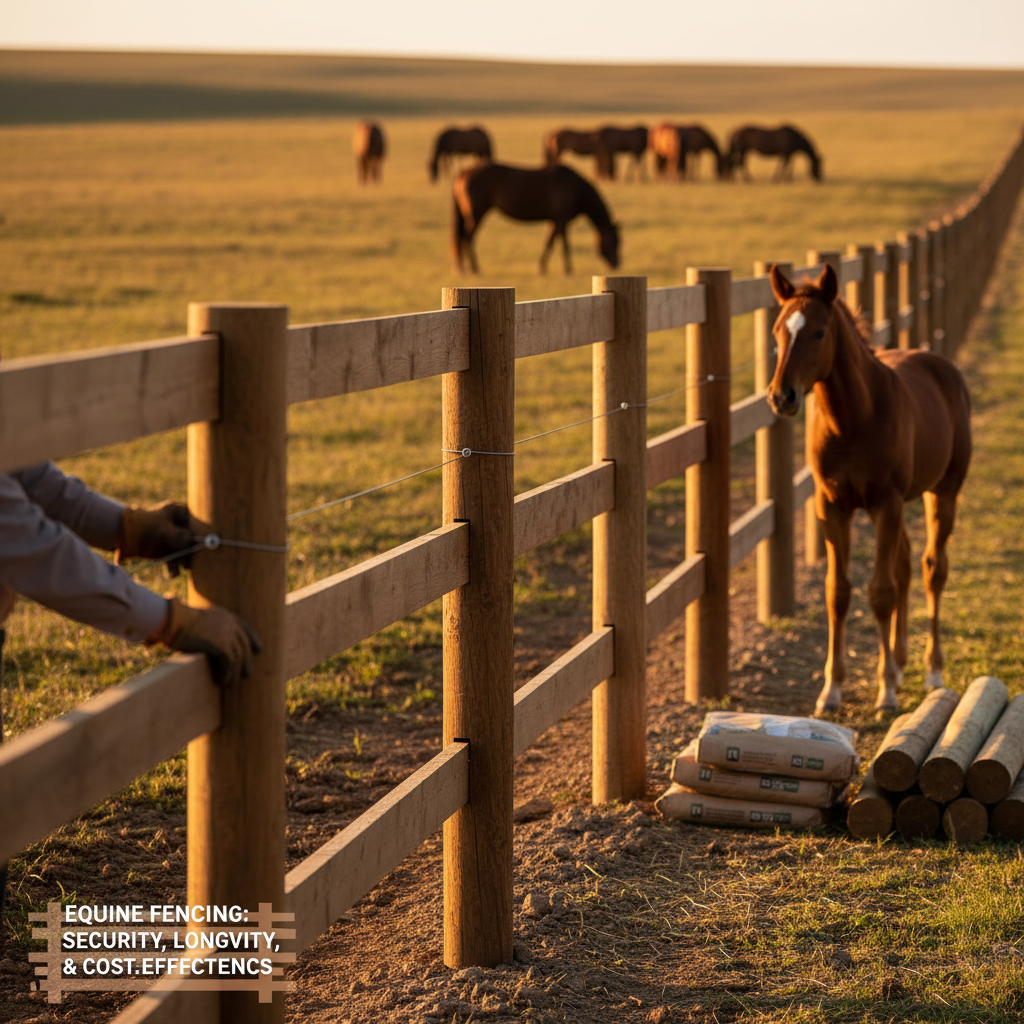
Wood post-and-rail or board. Agdex 460/722-1 describes post-and-board fences as strong and highly visible, and notes that they need maintenance: horses may lean on them and loosen boards and posts; setting posts carefully (the 1985 text says concrete can help keep a fence tight, and that a good job of tamping is adequate in most situations) matters more than the stain colour. The same publication warns that lead-based paints are poisonous and should not be used on livestock facilities, and that some horses will chew lumber, especially in small areas. Visibility is a real safety feature: a horse that can see the fence is less likely to run through it.
Pipe or metal. The 1985 fact sheet calls pipe fences with metal posts expensive at first, with low maintenance if posts are well set, and "strong, safe and attractive." Current installed prices belong in a local bid, not in this article.
Wire mesh and coated or high-tensile wire. The 1985 text says wire-mesh fences are less expensive to build and will give if a horse runs into them or leans on them, which means they need restretching. Modern coated high-tensile and non-climb mesh are widely used on horse properties; get a current installed quote rather than relying on a generic per-foot range. Visibility (a top rail, a rail, or a sight-line) still matters when the wire itself is thin.
Electric tape, rope, or wire. Agdex 460/722-1 says electric fences can be inexpensive and effective for training horses, that there is a risk of injury when more than 12 volts are used, that smooth wire at low voltage is described as fairly safe in that publication, and that electric fences can be hard to see unless you add visibility (the 1985 suggestion is strips of cloth). Keep weeds off the wire to reduce shorting. An electric offset on a board or mesh fence is a common modern combination; have a qualified person specify a livestock energizer that is legal and appropriate where you live.
Barbed wire. The October 2026 farm-input survey prices a defined barbed-wire spool. The 1985 Agdex chapter says most horses then spent their lives inside barbed-wire fences, that a strong, tight barbed-wire fence "can safely be used in large pastures," and that this type of fence should not be used to enclose stallions, or for corrals. That is the official 1985 wording. This article will not upgrade it into a modern ban, and it will not recommend barbed wire for small paddocks, dry lots, or high-traffic corners. Ask your veterinarian, insurer, and an equine-knowledgeable fencer what they will actually stand behind in 2026.
Chain link. The 1985 fact sheet calls chain link highly effective and long lasting, and expensive, with some give if a horse hits it, but a risk of permanent stretch if horses lean on it.
Corner posts and bracing decide whether a wire fence stays tight. The 1985 text is blunt: if a line post fails it can be replaced; if a corner post fails on a barbed or woven-wire fence, the whole run may need to be restretched. Treated posts last longer than untreated ones and "are recommended" in that publication. The October 2026 official post price above is a starting point for material, not for corners, gates, or labour.
Installation, maintenance, and the paddock the fence encloses
A fence budget is not only materials. It is gates that swing after a frost, a dry-lot run that takes more abuse than a 40-acre pasture, and a year of tightening, staining, and clearing weeds. Equestrian Canada's 2022 Table 6 puts Alberta recreation capital costs for buildings and fences at $448 per equine per year, and facility repair and maintenance at $1,045 — 2022 survey figures, before sales tax, not a 2026 contractor bid. Use them as context in a barn profit or ownership budget, then collect current quotes. See Beyond the Board Bill: True Equine Facility Maintenance Costs and The Cost of Owning a Horse in Canada.
For sacrifice paddocks and dry lots, which concentrate wear, see Sacrifice Paddock and Dry Lot Design. Height, rail spacing, and mesh opening should be specified by someone who fences horses on your ground. There is no official "standard Alberta height" in the sources below.
Horse fencing is not cattle fencing
Cattle often lean into a fence to reach grass. Horses are more likely to flee, rub, or strike, and they see poorly straight ahead, so a thin, dull wire is easy to run through unless it has a visible rail, a top board, or another sight-line. Mesh or rail openings that can catch a hoof or a shoe are a design problem, especially in small paddocks and dry lots. A well-built corner — braced and anchored — is what keeps a wire fence tight; as the 1985 fact sheet notes, a failed corner can mean restretching a whole run, which costs more than building the corner properly the first time.
The upfront material price is only part of the cost of ownership. Installation labour, equipment, and the years of tightening, staining, and replacing damaged sections belong in the same budget as the posts and wire. Use the official farm-input lines as material context, then collect written quotes for the system you actually want, installed on your ground.
FAQ
What is the safest fence for horses? No fence is horse-proof. The 1985 Alberta fact sheet emphasizes visibility, adequate construction, and not using barbed wire for stallions or corrals. A visible rail or board plus a well-built corner is a more useful starting point than a marketing label.
How high should a horse fence be? Ask an equine-knowledgeable installer, and look at what is already working on comparable Alberta properties. The sources below do not set a single official height.
How much does it cost to fence an acre in Alberta? There is no official 2026 installed price in the sources below. Use the official farm-input post, wire, and lumber lines as material context, then get written quotes for the system you want.
Can I use barbed wire for horses? The 1985 Agdex says a strong, tight barbed-wire fence can be used in large pastures and should not be used for stallions or corrals. Confirm current practice with your veterinarian, insurer, and fencer before you buy a spool, even though the farm-input survey still prices one.
How often should I inspect a horse fence? The official sources fetched here do not set a calendar. A practical habit is to walk or ride the fence after storms, frost heave, and any escape or impact, and to check corners and gates more often than mid-span wire.
Sources
- Alberta Agriculture, Horse Handling Facilities, Agdex 460/722-1 (revised 1985). https://open.alberta.ca/dataset/808ca330-589e-4fad-95b2-0dfac083c314/resource/4b98390c-5140-4ba3-9624-9821d7faa974/download/163010276893-horse-handling-facilities.pdf
- Alberta Agriculture and Irrigation, Alberta Farm Input Prices, October 2026 (published 5 November 2026). https://open.alberta.ca/dataset/f2432af0-cffa-4a86-9c31-74e6ec5c5afa/resource/d5a293ae-2d95-40d5-933d-035cb6ba4bf1/download/agi-tedab-monthly-farm-input-prices-2026-10.pdf
- Equestrian Canada, Socio-Economic Impact Assessment of the Canadian Equine Sector — Supplementary Information, Table 6 (2022). https://equestrian.ca/wp-content/uploads/2024/05/EC-Impact-Assessment-Supplementary-Information.pdf
This article is general information, not veterinary advice. Talk to your veterinarian about your horse.