How Many Acres Does a Horse Need in Alberta?
By Claire Halden
Official Alberta figures start at 4–6 acres of cultivated pasture per horse per summer. See how stocking rates work, and use a free calculator.
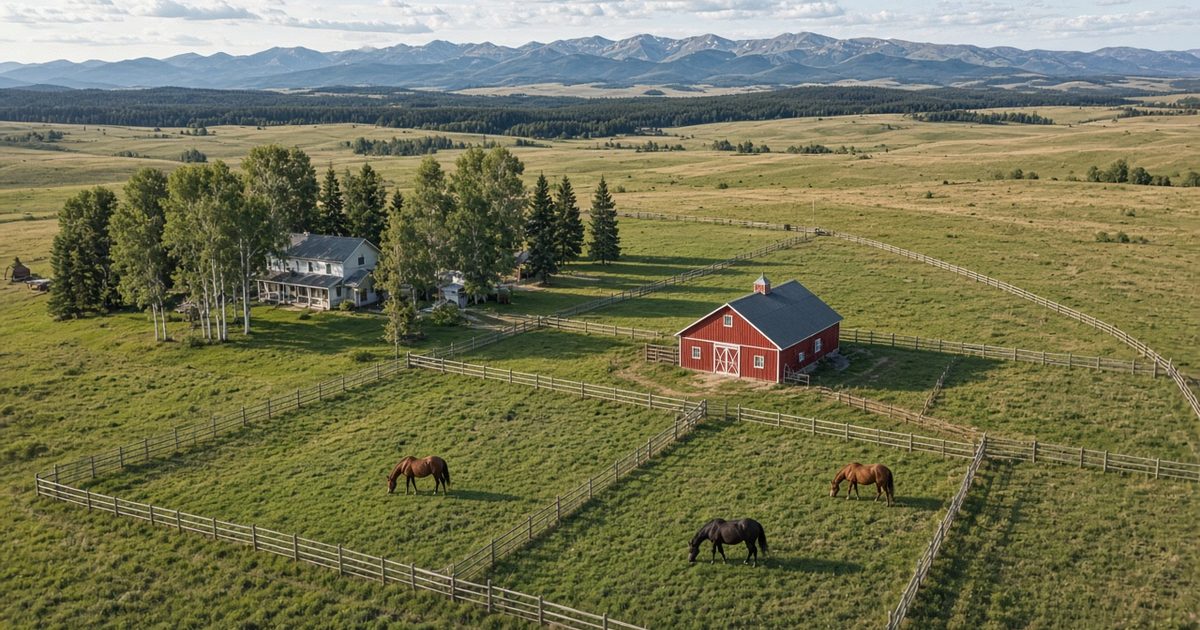
This article is educational and is not a substitute for a range or forage specialist's advice. Stocking rates depend on rainfall, forage type, irrigation, and management. A single "acres per horse" number is a starting point, not a property-size guarantee.
"How many acres does a horse need?" is the question that decides whether a 10-acre acreage is a pasture or a dry lot with a view. The honest answer in Alberta is: more than many U.S. extension pages assume, and more still if the grass is native range rather than tame pasture.
The Equine Tools Hub pasture stocking calculator will apply a stocking rate once you have a forage estimate. The official figures below explain why that rate is not the same in central Alberta as it is in Minnesota.
Official Alberta starting points
Alberta Agriculture's Agdex 460/50-1, Horse Management: Feeding (issued 1975), states that the carrying capacity of pasture varies from 1.5 to 2.5 hectares (4–6 acres) per horse per summer for cultivated pasture, to 3 to 5 hectares (8–12 acres) per horse per season for native pasture. If the pasture is overgrazed, carrying capacity falls considerably. The same page calls overgrazing (less than 5 cm of residual grass) the most serious pasture problem in Alberta, and notes that the pasture season in western Canada is only 3 or 4 months, compared with 7 or 8 months in "traditional" horse-raising areas. Those sentences are nearly fifty years old. They are still the clearest official Alberta "acres per horse" range used here, and they should be read as a dated government starting point, not as a 2026 soil survey.
A later Alberta Agriculture, Food and Rural Development guide, Manure and Pasture Management for Horse Owners by Dr. Lori K. Warren and Christine Sweet (PDF created 2004), gives a method you can update with your own forage yield:
Pasture acres required = (number of horses × average body weight in pounds × 0.035 × number of grazing days) ÷ average forage production in pounds per acre.
Their worked example: two 1,100-pound horses, 120 grazing days, and 2,000 pounds of forage per acre:
(2 × 1,100 × 0.035 × 120) ÷ 2,000 = 4.6 acres for those 120 days, or about 2.3 acres per horse for that short season, at that yield.
The 0.035 factor is the guide's planning assumption for forage disappearance, not a promise of how much your horse will eat. Daily hay intake is a different number; see How Much Hay Does a Horse Eat a Day?.
The same guide's Table 10 estimates acres needed to support one 1,100-pound (500 kg) horse for one month, by annual precipitation and pasture quality. Selected rows:
- 10–14 inches (250–350 mm) of precipitation: 1.7 acres (excellent pasture), 2.5 (good), 5.0 (poor)
- 14–18 inches (350–450 mm): 1.0, 1.5, and 3.3 acres
- 18–22 inches (450–550 mm): 0.6, 0.9, and 1.7 acres
- 22–26 inches (550–650 mm): 0.4, 0.6, and 1.1 acres
- Irrigation: 0.2, 0.3, and 0.5 acres
Those are acres per horse per month. A five-month grazing season on "good" pasture in the 14–18 inch band would be 1.5 × 5 = 7.5 acres per 1,100-pound horse, before you adjust for a heavier horse (the guide says to scale by weight: a 1,300-pound horse on the 1.0-acre excellent/14–18-inch line would need 1.18 acres per month). Many Alberta locations sit in the drier bands. Check your own precipitation rather than assuming the wetter rows.
Table 9 in the same guide, using grazing research data from Lacombe, Alberta (courtesy of Dr. Vern Baron, Agriculture and Agri-Food Canada), reports average forage production on well-managed grass pasture of 6,600 pounds per acre over the grazing season, and 10,300 pounds per acre on grass-legume pasture, with roughly 60 percent of Alberta pasture forage produced by early July. Those are well-managed research yields, not a promise for an overgrazed acreage paddock.
Why U.S. "two acres per horse" can undershoot on the prairies
University of Minnesota Extension (reviewed 2023) says pastures can usually provide enough forage for one horse for every two acres during the grazing season, that pastures less than one acre per horse are not ideal, and that two acres per grazing horse will reduce dependency on hay during the growing season. That is a useful humid-climate planning figure. It is not an Alberta carrying-capacity study. A Minnesota two-acre rule, applied to dry native range, is how pastures become dry lots.
Penn State and Rutgers publish their own ranges as well; this article sticks to the Minnesota page that was opened in full and to the Alberta guides above. If your land is irrigated tame pasture with excellent management, your rate may move toward the denser end of Table 10. If it is native grass in a dry year, it may move toward Agdex's 8–12 acres, or you may be buying hay for most of the year.
Dry lots are part of the acreage math
Not every acre of a horse property is pasture. University of Minnesota says dry lots, or sacrifice paddocks, should provide at least 400 square feet per horse, plus shelter, water, and space to feed hay, and that they let you take horses off pasture in wet or dry conditions or when the grass needs rest. Alberta's drought-management fact sheet (Agdex 460/50-4, reviewed August 2009) likewise recommends a sacrifice area so hooves do not wreck a dry pasture, and says that to avoid overgrazing you should reduce stocking or turnout time when forage growth falls.
An acreage with three acres of grass and a well-built dry lot can be a good home for a horse. It is not "three acres of pasture" in the Agdex sense if the grass is only a turnout pen. Budget hay for the months — often most of the year in Alberta — when the pasture cannot carry the horse. The hay bale cost calculator and Alberta Hay Prices in 2026 are the companion tools.
A practical way to size the property
- Decide whether the grass is meant to feed the horse or only to provide turnout. If it is only turnout, size a dry lot properly and budget a full hay ration.
- If it is meant to feed, estimate forage yield (a hay test and a realistic look at last year's growth beat a generic "2,000 pounds").
- Run the Warren and Sweet formula, or Table 10, for your precipitation and season length. Then run the pasture stocking calculator.
- Compare the result with Agdex's 4–6 acres (cultivated, per summer) or 8–12 acres (native, per season) as a sanity check.
- Leave room for rest and rotation. The 1975 Agdex page says not to graze until new growth is about 10 cm (about mid-May in its telling) and to stop when only 5 cm remains.
- Revisit the number in a drought year. Agdex 460/50-4 is blunt: a drought-stricken pasture produces less forage, which means fewer horses.
For design of the dry lot itself, see Sacrifice Paddock and Dry Lot Design. For the cost of keeping the horse when the grass gives out, see The Cost of Owning a Horse in Canada.
FAQ
Is two acres per horse enough in Alberta? Minnesota uses about two acres per horse during the grazing season as a general figure. Official Alberta starting points are higher for many situations: 4–6 acres of cultivated pasture per horse per summer, or 8–12 acres of native pasture per season, in Agdex 460/50-1 (1975). Use the Warren and Sweet formula and your own yield before you buy a property on a two-acre rule of thumb.
How do I adjust for a bigger or smaller horse? The Alberta manure-and-pasture guide scales Table 10 by weight relative to 1,100 pounds. A 550-pound weanling on the same line needs half the acres; a 1,300-pound horse needs more.
Does irrigation change the number? Table 10 includes an irrigation row as low as 0.2–0.5 acres per horse per month, depending on pasture quality. That is a monthly figure for irrigated land in that table, not a reason to stock a dry paddock at that density.
Can I keep a horse on one acre? Minnesota says pastures less than one acre per horse are not ideal. You can keep a horse on a small acreage with a dry lot and purchased hay. That is a management system, not a stocking rate that will feed the horse from grass.
Why does Alberta's number seem so high compared with what I read online? Shorter grazing seasons, lower or more variable precipitation, and a lot of native range. The 1975 Agdex page notes a western Canadian pasture season of only three or four months.
Where do I run my own numbers? The pasture stocking calculator, using a forage yield you can defend.
Sources
- Alberta Agriculture, Horse Management: Feeding, Agdex 460/50-1 (issued 1975). https://open.alberta.ca/dataset/ee03e05e-0f22-47dc-97c2-27c538e9d5cb/resource/538fb04d-c0ff-47dc-8ec3-d798a6a9edd6/download/163210377657-horse-management-feeding.pdf
- Alberta Agriculture, Food and Rural Development, Lori K. Warren and Christine Sweet, Manure and Pasture Management for Horse Owners (PDF created 2004). https://www1.agric.gov.ab.ca/$department/deptdocs.nsf/ba3468a2a8681f69872569d60073fde1/3d52f2f2a596cca78725827200722bb4/$FILE/Manure_and_Pasture_Management_for_Horse_Owners.pdf
- Alberta Agriculture and Rural Development, Feeding and Management Considerations for Horses, Agdex 460/50-4 (reviewed August 2009). https://www1.agric.gov.ab.ca/$department/deptdocs.nsf/all/agdex9622/$FILE/feeding-and-management-considerations-horses.pdf
- University of Minnesota Extension, Krishona Martinson, "Planning your horse pasture site" (reviewed 2023). https://extension.umn.edu/agriculture/animals-and-livestock/horse/pasture-site-planning
This article is general information, not veterinary advice. Talk to your veterinarian about your horse.