Sacrifice Paddock and Dry Lot Design: Footing, Drainage, and Costs
By Mark Dunlop
Size and drain a sacrifice paddock with official manure and area figures from Alberta and University of Minnesota Extension.
This article is educational. It is not a grading or drainage design. Use a contractor who has built livestock pads, and check municipal drainage and manure rules.
A sacrifice paddock, or dry lot, is the place you put horses when the pasture is too wet, too dry, or too short. It concentrates hooves, manure, and hay waste on a small surface, which is exactly why it has to be built on purpose.
The Alberta manure-and-pasture guide (Warren and Sweet) assumes about 20 kg (45 lbs) of manure per horse per day. University of Minnesota Extension (pasture site planning) says dry lots should provide at least 400 square feet per horse, plus shelter, water, and a place to feed hay. Those are the official anchors. Get local quotes for construction; this article does not set an install price.
The pasture stocking calculator and How Many Acres Does a Horse Need in Alberta? explain why a short Alberta grazing season makes a dry lot almost a requirement, not a luxury. Agdex 460/50-4 (reviewed August 2009) recommends a sacrifice area so hooves do not wreck a dry or wet pasture.
Siting and drainage
Pick a high, well-drained site that does not shed dirty water into a well, a creek, or the neighbour's yard. A slight slope so water leaves the pad is sound engineering. A contractor can shoot grade; you can look, after a rain, at where water already wants to go, and keep the manure pile and the well apart. The sources below do not set a single official grade percentage for Alberta.
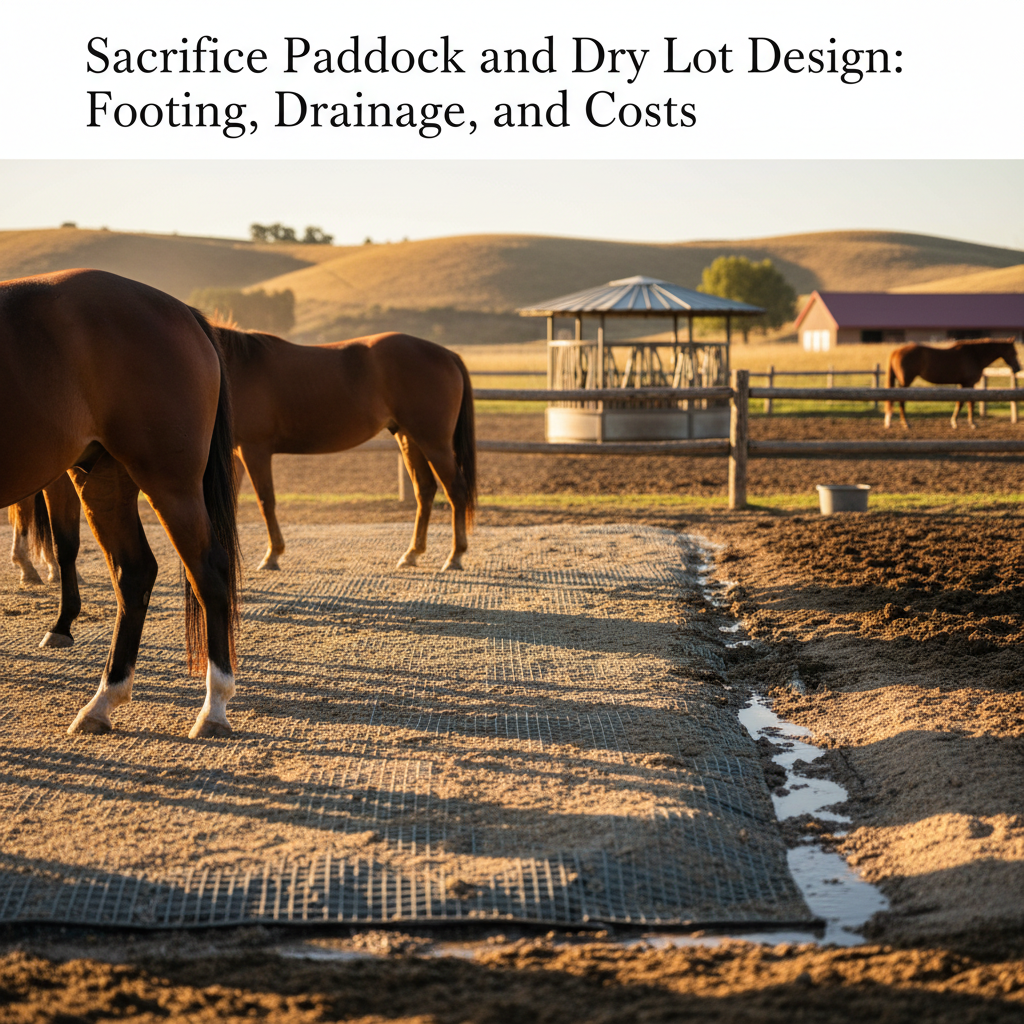
A typical built-up pad, described without a price list, is: a prepared subgrade; a geotextile so mud and rock do not mix; a compacted base; optional grid or mats in the high-traffic gates and feeder; and a working surface you can pick manure off. Gates and waterers fail first. Put water on a pad (the 1985 Agdex apron of 1.8 to 3 m around a corral waterer is a dated official starting point; see the waterers post). Feed hay in a way that does not bury it in mud; waste matters to the hay bale cost calculator and to How Much Hay Does a Horse Eat a Day?.
Fence a dry lot for close contact, not for a 40-acre pasture. See fencing. The 1985 Agdex warning not to use barbed wire for corrals is especially relevant on a small, high-traffic lot.
Manure, sand, and winter
At about 45 pounds of manure per horse per day, a two-horse lot is a daily chore, not a spring project. Pick it before it is ground into the footing. Compost or store it off the pad and away from water. Winter adds ice; summer adds dust. Neither is a reason to skip the pick.
Sand or fine aggregate can be swallowed with hay and is a colic risk if horses eat off the lot surface. Feed in tubs, on mats, or in feeders, and do not leave loose hay on sand. Body-condition score horses that live in a lot all winter; they cannot graze their way to a healthy weight, and they need unfrozen water. See Winter Water and Feed for Horses in Alberta.
For cost, use invoices and, if you want a survey anchor, Equestrian Canada 2022 Table 6 Alberta recreation facility lines (capital costs for buildings and fences $448, facility repair $1,045 per equine per year). Those are not a pad bid. Official farm-input fence posts ($9.57 for a defined 7-foot treated post in October 2026) are material context only.
FAQ
What is the best fence for a small sacrifice paddock? A visible, close-contact fence specified for horses. The 1985 Agdex says not to use barbed wire for corrals. Get a local quote rather than a generic per-foot price.
Can I use pea gravel as a surface? Ask a contractor who has built horse pads. Some small, round gravels roll and pack into hooves; this article does not bless or ban a product that was not tested here.
How do I stop the gate from becoming a bog? Build the traffic path as carefully as the pad, give water a way out, and do not skimp on base under the swing of the gate.
How long does a dry lot last? It lasts as long as you pick manure, fix grade, and replace footing. The official sources fetched here do not give a year count.
Sources
- Alberta Agriculture, Food and Rural Development, Lori K. Warren and Christine Sweet, Manure and Pasture Management for Horse Owners (PDF created 2004). https://www1.agric.gov.ab.ca/$department/deptdocs.nsf/ba3468a2a8681f69872569d60073fde1/3d52f2f2a596cca78725827200722bb4/$FILE/Manure_and_Pasture_Management_for_Horse_Owners.pdf
- University of Minnesota Extension, Krishona Martinson, "Planning your horse pasture site" (reviewed 2023). https://extension.umn.edu/agriculture/animals-and-livestock/horse/pasture-site-planning
- Alberta Agriculture, Feeding and Management Considerations for Horses, Agdex 460/50-4 (reviewed August 2009).
- Alberta Agriculture, Horse Handling Facilities, Agdex 460/722-1 (revised 1985).
- Equestrian Canada, Table 6 (2022); Alberta farm-input prices, October 2026.
This article is general information, not veterinary advice. Talk to your veterinarian about your horse.