Stall Bedding: Unpacking the Actual Cost and Benefits
By Mark Dunlop
Compare stall bedding on absorbency, dust, labour, and disposal, using Equestrian Canada's 2022 Alberta bedding average.
This article is educational. It is not a product test or a 2026 price list.
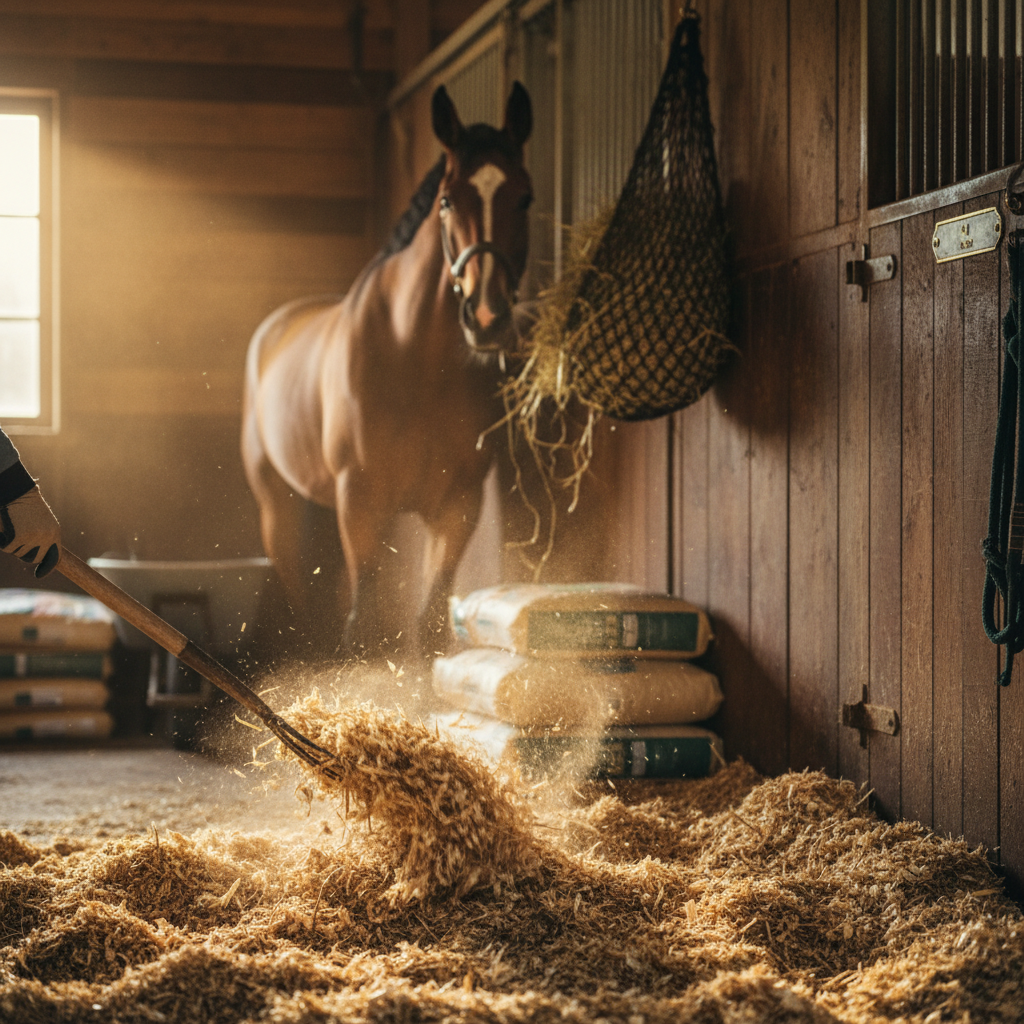
Many owners shop bedding by the bag. The true cost is the bag, the labour to pick and strip, the dust in the aisle, and the manure pile it becomes. Use a current Alberta supplier invoice for bag and bale prices, and the official survey line below for context — not a generic share of "the barn budget."
Equestrian Canada 2022 Table 6 reports Alberta recreation bedding at $262 per equine per year, inside a recreation total of $11,261, before sales tax. That is a 2022 survey average, not a 2026 truckload quote, and it will not match a deeply bedded foaling stall. Use it as a budget anchor in the barn profit calculator or the boarding cost calculator, then get local prices. See How to Build a Boarding Barn Profit-and-Loss Statement and Cost of Owning a Horse in Canada: Survey Data and 2026 Prices.
How to compare materials without a fake price table
Judge each product on the same five things: absorbency, dust, labour (daily pick versus how often you strip), disposal (volume, composting, municipal rules), and availability where you live. Hoof health and respiratory health are the welfare tests that sit above a few dollars a bag.
Wood shavings. Widely available, easy to pick, variable in dust and particle size. Ask what species and whether the load is kiln-dried. Softwood shavings are the usual stall product; do not assume a random sawmill pile is horse-safe.
Wood pellets. Often lower storage volume and, once fluffed with water, a smaller daily pile to pick. They are not automatically cheaper; do the per-stall math on your invoice. Some horses find the first wetting unfamiliar.
Straw. Traditional, warm to the eye, and still common for foaling when you want a deep, bright bed. It is bulkier to dispose of, can be dusty or weedy, and is a poor choice if the horse will eat a dirty bed. Official hay prices in the farm-input survey are for good-quality hay, not for bedding straw; do not substitute $173.43 per ton as a straw price.
Peat and hemp. Used where they are sold. Ask about dust, disposal, and whether your manure system can handle them. Get a local price.
Mixes are fine if you still know what you are measuring. A "cheap" stall that has to be stripped twice as often is not cheap in labour. If you hire help, the October 2026 farm-input general farm labour average is $4,147.94 per month, full-time, without board — a provincial farm-labour line, not a stall-cleaning wage, but a reminder that labour dwarfs a bag price.
For boarded horses, ask whether bedding is included and what the bag fee is if you want a deeper bed; see Beyond the Brochure.
Dusty bedding is a respiratory problem, especially in a tight barn in January. Buy the cleaner lot, store it dry, and ventilate. See Barn Fire Prevention: Electrical Standards and Evacuation Planning on dust and feed in the stable, and Winter Water and Feed for Horses in Alberta if horses are in more because the paddock is ice.
FAQ
What is the most absorbent stall bedding? It depends on the lot and how you use it. This article will not crown a product we did not test. Compare absorbency on your floor, not on a marketing card.
Is dusty bedding bad for horses? Yes. Dust is a respiratory risk. If you can see a cloud when you open a bag, it is the wrong bag.
Can I mix bedding types? Yes, if you still know how you will pick and dispose of the mix.
How often should I strip a stall of pellets? When the base is dirty or wet, not on an invented calendar. Daily picking still matters.
What bedding is best for foaling? Ask your veterinarian. Straw is traditional; cleanliness and a deep, low-dust bed matter more than the brand.
Sources
- Equestrian Canada, Socio-Economic Impact Assessment, Table 6 (2022). https://equestrian.ca/wp-content/uploads/2024/05/EC-Impact-Assessment-Supplementary-Information.pdf
- Alberta Agriculture and Irrigation, Alberta Farm Input Prices, October 2026 (published 5 November 2026).
This article is general information, not veterinary advice. Talk to your veterinarian about your horse.