Small Square vs. Round Bales for Horses: Waste, Storage, and Cost per Pound
By Claire Halden
Compare small square and round hay bales for horses using extension waste and storage figures, and a calculator for cost per pound.
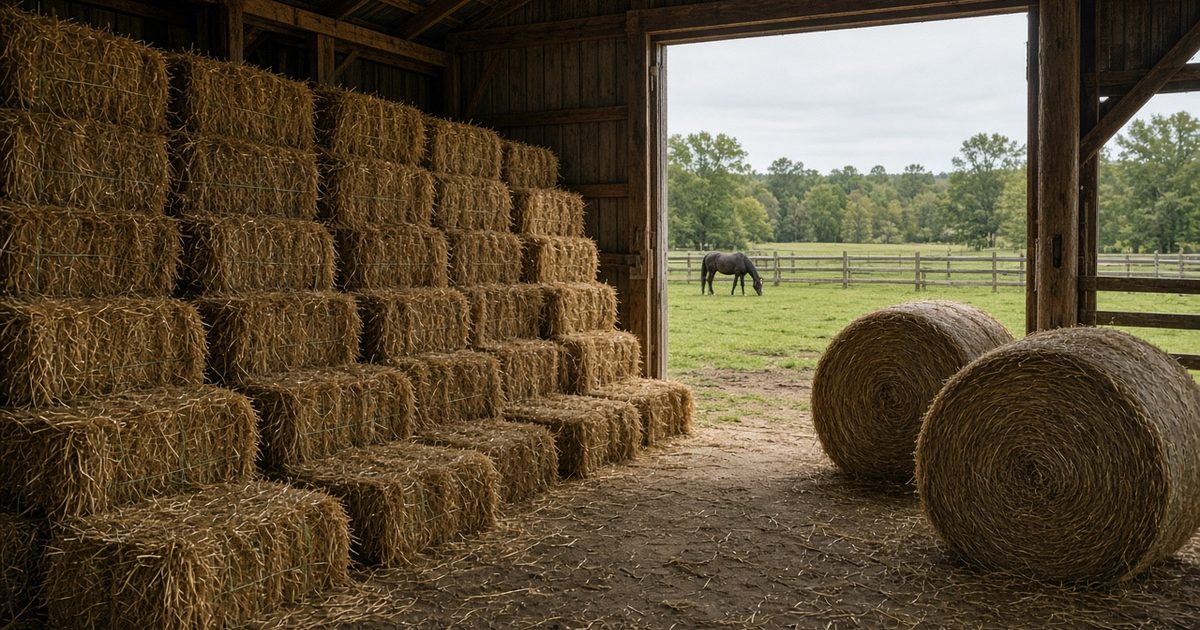
This article is educational. It is not a recommendation to buy a particular bale type or feeder. Waste and storage figures come from university research, mostly from the U.S. Midwest; your Alberta weather, feeder, and hay quality will change the result.
The debate in the hay shed is usually framed as "squares versus rounds." The more useful question is: what does a pound of hay that the horse actually eats cost, after waste and storage loss? A cheap round bale left on the ground can become expensive hay. A tidy small square, bought without weighing it, can be expensive too.
The Equine Tools Hub hay bale cost calculator is built for that comparison, once you know bale weight, price, and a realistic waste percentage.
First, weigh the bale
Official sources do not agree on one "standard" bale weight, because there isn't one.
Ontario's Ministry of Agriculture, Food and Agribusiness (OMAFRA) assumes a 50-pound small square bale in its illustrations, and immediately warns that weight varies from as low as 30 pounds up to 60 pounds. The ministry's advice is to weigh a number of bales and get an average.
Cornell Cooperative Extension, in a 2018 small-farms article, describes typical small square bales as about 35 to 40 pounds each, and a typical 4-foot by 4-foot dry round bale as just under 700 pounds. The same article says a wrapped wet bale of baleage, which contains the same amount of nutrients as the dry round bale but more water, can weigh 1,200 pounds, and that livestock needs should be figured on a dry-matter basis.
If you are buying 5-by-6-foot or hard-core rounds, weigh them rather than assuming a catalogue weight. University of Minnesota Extension notes that it can be difficult to estimate weight for large rounds and large squares because density varies, and that you may be able to weigh a load at a truck stop or gravel pit, or use a bathroom or luggage scale for small squares.
Minnesota's buying example, in the dollars that page uses, is the one to keep on the barn door: a 35-pound square bale sold for $5 is $286 per ton, while a 50-pound bale sold for $6 is $240 per ton. The cheaper-looking bale is the worse buy.
For an Alberta farm-gate context, Alberta Agriculture's October 2026 survey average was $173.43 per ton for good-quality hay with more than 50 percent alfalfa. That figure is a provincial average, and the survey lists hay in "ton" without spelling out the conversion in the October 2026 PDF. If you treat that unit as 2,000 pounds for illustration, a 50-pound square would pencil at $4.34 and a 700-pound dry round at $60.70 — before delivery, waste, or a different hay type. Confirm the unit and the actual bale weights with the seller. See Alberta Hay Prices in 2026 for how to read that official average.
Feeding waste: this is where rounds often lose
University of Minnesota researchers have measured hay waste with and without feeders. The figures below are from Minnesota's 2024 "stretch your hay supply" summary and from the underlying round-bale feeder study (reviewed 2024), which University of Maryland Extension also reprints.
Small square bales
- Indoors: 7 percent waste without a feeder, versus 1 percent with a feeder.
- Outdoors: 13 percent waste without a feeder, versus 1 to 5 percent with a feeder.
Maryland's table of Minnesota's small-square work lists basket feeders at 3 percent waste, hayracks at 5 percent, slat feeders at 1 percent, and no feeder at 13 percent, with hay intake of 2.2 to 2.4 percent of body weight.
Round bales, fed outdoors
- With a feeder: 5 to 33 percent waste, depending on design.
- Without a feeder: 57 percent waste.
In Minnesota's nine-feeder trial, the most restrictive designs wasted as little as 5 to 11 percent (for example, Waste Less at 5 percent and Cinch Net at 6 percent). Designs that allowed more access wasted 13 to 33 percent (Hay Sleigh was 33 percent). Horses eating from feeders consumed 2.0 to 2.4 percent of body weight. Horses with no feeder ate only 1.3 percent of body weight, and the herds without a feeder had an average weight loss of 225 pounds for the herd. Minnesota attributes the lower intake and the weight loss to spoilage: without a feeder, horses can trample hay and pass manure or urine on it.
A Texas study cited by Minnesota found waste of 38 percent for coastal bermudagrass and 31 percent for alfalfa when rounds were fed without a feeder, versus 2 and 9 percent with a ring feeder. That is a different forage and climate, but the direction is the same: a feeder changes the math.
OMAFRA, writing about hay fed on the ground, says 20 to 25 percent of the nutrient value can be lost into the dirt, especially with leafy alfalfa. NDSU Extension has also noted that a feeder can reduce waste to less than 20 percent — a coarser figure than Minnesota's design-by-design table, but the same recommendation.
Minnesota's 2024 hay-supply page says thousands of dollars worth of hay are wasted without a feeder, and that all of the feeders in their work paid for themselves within one year. Payback in their round-bale table, at an assumed $100 per ton, ranged from 0.8 months for a Cinch Net to 20 months for a Covered Cradle. That $100-per-ton assumption is Minnesota's study figure, not an Alberta 2026 price. Re-run payback at your actual hay cost.
Storage waste: rounds left outside pay twice
Round bales normally have higher storage waste than small squares, especially outdoors. Minnesota's round-bale page says storage can cause 2 to 40 percent hay waste depending on forage type, storage method, environment, and length of storage. Outdoor storage waste ranges between 5 and 35 percent, depending on rain or snow, the site, and the original condition of the bale. Most of that waste is on the bottom, where moisture is higher and airflow is poor.
The same page notes that the outer 4-inch layer of a 6-foot-diameter round bale contains about 25 percent of the total bale volume, and that weather will likely damage this layer if bales are stored improperly or unprotected. Storing hay inside can reduce storage waste by about two-thirds. A good plastic covering can reduce waste by one-half when bales are stored outside.
Minnesota's 2024 hay-supply page reports dry-matter losses when harvesting and storing rounds outdoors of nearly 20 percent for sisal twine, 11 percent for plastic twine, 7 percent for net wrap, and minimal losses with B-Wrap. When rounds were stored outdoors without cover, dry-matter loss was 7 to 49 percent; only 2 to 6 percent was lost when rounds were stored indoors.
University of Maryland Extension, summarizing the same research, says storage waste can be up to 40 percent depending on forage type, method, environment, and length of storage, that outdoor storage waste ranges from 5 to 35 percent, and that storing hay inside can potentially reduce waste by about two-thirds.
Practical outdoor storage steps from Minnesota include: buy or make a tightly packed bale; use plastic wrap, net wrap, or plastic twine (net-wrapped grass bales stored outside can reduce waste by 32 percent compared with twine bales); store on a well-drained 4- to 6-inch coarse rock base or on wooden pallets; never store bales under trees; and keep a temporary cover in place for the whole storage period.
For a horse owner in Alberta, that list is not optional colour. Snow sitting on an uncovered round, and a wet bottom on bare ground, is exactly the loss those percentages describe.
Labour, equipment, and how horses are fed
Cornell's small-farms discussion is a reminder that bale type is also a labour and equipment choice. Small squares generally take more handling; rounds usually require a tractor with a spear or loader. Many horse owners stay with small squares because they can feed a measured amount, store bales in a loft, and do not own a loader. OMAFRA notes that there will always be a market for small square bales of quality hay, as most horse owners do not have the equipment to handle large rounds or large squares, though some growers may deliver large bales into feeders on a weekly basis.
If you do feed rounds, Minnesota's safety notes are worth taking seriously: injuries were uncommon with the tested feeders, but cosmetic rub marks can occur, and when a hay net is used alone the round bale can collapse so that horses stand and pass manure or urine on the remaining hay. A net plus another feeder avoids that problem.
Daily intake does not change just because the hay arrived as a round rather than a square. A 1,000-pound idle horse is still planned at about 20 pounds of hay a day in Minnesota's standard example, or 22 to 24 pounds as fed in OMAFRA's dry-matter range. What changes is how many extra pounds you must buy to cover waste. For amounts, see How Much Hay Does a Horse Eat a Day? and Pasture & Hay: Optimal Equine Nutrition & Cost-Efficiency.
A simple comparison method
- Weigh several bales, or a full load, and record the average.
- Get the price, and whether it is farm gate or delivered, per bale, per ton, or per tonne.
- Convert to dollars per pound in the hay bale cost calculator.
- Add a waste percentage that matches your setup, using the Minnesota figures as a starting point: for example, 1 to 5 percent for small squares in a feeder, versus 5 to 11 percent for a restrictive round-bale feeder, 13 to 33 percent for a more open round feeder, or up to 57 percent for a round with no feeder, plus storage loss if the hay will sit outside.
- Compare the resulting cost per pound eaten, not the cost per bale on the invoice.
- Factor in labour, storage space, and whether you can feed a measured amount to an easy keeper. A free-choice round is a poor tool if the horse should be eating 1.5 percent of body weight, not 2.4 percent.
FAQ
Are round bales safe and appropriate for horses? They can be, if the hay is horse-quality (no mold, appropriate for the horse) and you use a feeder. Minnesota found injuries uncommon with the tested feeders, but waste and spoilage were severe without one, and herds without a feeder lost weight.
How much more waste should I expect from a round bale? It depends on the feeder. Minnesota measured 5 to 33 percent feeding waste with round-bale feeders, versus 57 percent with no feeder, compared with 1 to 5 percent for small squares outdoors with a feeder and 1 percent indoors with a feeder.
What does a typical bale weigh? OMAFRA: small squares often 30 to 60 pounds, with 50 pounds used in examples. Cornell: typical small squares about 35 to 40 pounds; a typical 4-by-4-foot dry round just under 700 pounds. Weigh yours.
Is it cheaper to buy rounds in Alberta? Only if the price per pound, after waste and storage, is lower. Start from a weighed bale and a quoted price. The October 2026 provincial farm-gate average of $173.43 per ton is a reference, not a round-versus-square price list.
Can I store rounds outside in an Alberta winter? You can, but Minnesota's outdoor storage losses of 5 to 35 percent (and higher in some uncovered trials) are a warning. Elevate, drain, cover, and prefer net wrap or plastic. Indoor storage cuts that loss substantially.
Do I still need to test the hay? Yes. Bale shape does not tell you energy, protein, or sugar. See Forage Quality: A Deep Dive.
Sources
- Ontario Ministry of Agriculture, Food and Agribusiness, "Hay for horses" (page updated 4 November 2026). https://www.ontario.ca/page/hay-horses
- Cornell Small Farms, Rich Taber, Cornell Cooperative Extension of Chenango County, "Hay You! Should I Make My Hay or Buy It?" (5 October 2018). https://smallfarms.cornell.edu/2018/10/hay-you-should-i-make-my-hay-or-buy-it/
- University of Minnesota Extension, "Ten ways to stretch your horse's hay supply" (reviewed 2024). https://extension.umn.edu/agriculture/animals-and-livestock/horse/stretch-hay-supply
- University of Minnesota Extension, "Feeding horses with a round-bale feeder" (reviewed 2024). https://extension.umn.edu/agriculture/animals-and-livestock/horse/feeding-horses-with-a-round-bale-feeder
- University of Maryland Extension, Erika Crowl, "Calculating Your Horse's Winter Hay Needs" (updated 7 April 2021). https://extension.umd.edu/resource/calculating-your-horses-winter-hay-needs
- North Dakota State University Extension, Carrie Hammer, "Feed Horses Properly in Winter" (29 January 2013). https://www.ag.ndsu.edu/news/newsreleases/2013/jan-28-2013/feed-horses-properly-in-winter
- Alberta Agriculture and Irrigation, Alberta Farm Input Prices, October 2026 (published 5 November 2026). https://open.alberta.ca/dataset/f2432af0-cffa-4a86-9c31-74e6ec5c5afa/resource/d5a293ae-2d95-40d5-933d-035cb6ba4bf1/download/agi-tedab-monthly-farm-input-prices-2026-10.pdf
This article is general information, not veterinary advice. Talk to your veterinarian about your horse.