Equine Supplements: Efficacy, Cost, and Necessity Examined
By Claire Halden
A forage-first way to judge horse supplements, using official Canadian keep-cost context, a simple evaluation checklist, and a free feed calculator.
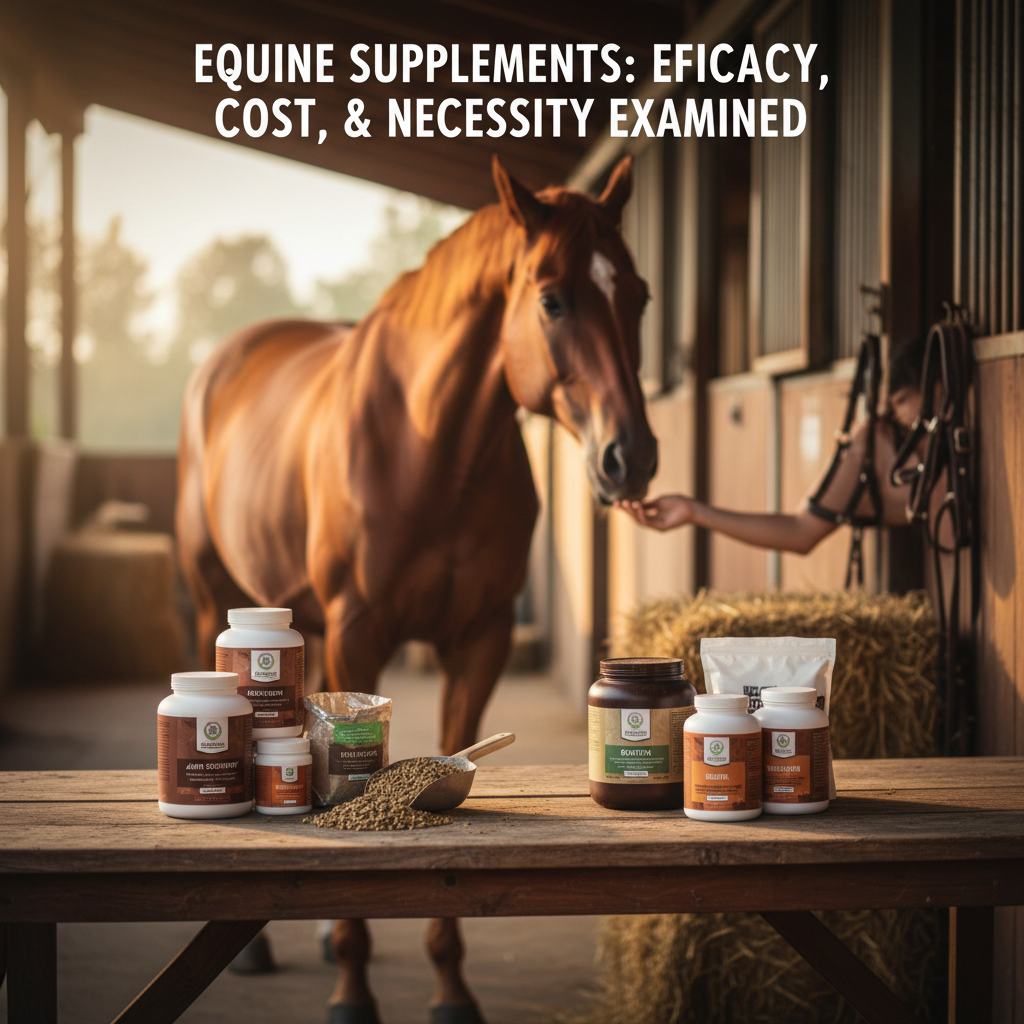
This article is educational and is not a veterinary or nutrition prescription. Do not start, stop, or stack supplements without advice from your veterinarian, especially if the horse is on medication, is metabolic, is a senior, or is in work.
The useful question is whether this horse, on this hay, needs a product, and how you would know if it helped. Price a candidate from the invoice in front of you, at the label rate for your horse's weight — not from a generic "typical daily cost."
Start with forage and a body weight. Agdex 460/51-1 (2008) keeps fibre at or above one percent of body weight. Minnesota plans most adults at about 1.5 to 2.5 percent of body weight in feed, with 2 percent a common target. Get a current weight with the horse weight calculator, score condition on the Henneke scale, and run a ration in the horse feed calculator. See How Much Hay Does a Horse Eat a Day? and Pasture and Hay.
Official cost context — with a caveat
Equestrian Canada 2022 Table 6 has an Alberta recreation line called "Other (manure disposal, supplements"): $40 per equine per year, inside a recreation total of $11,261. That is a mixed category. It is not "Albertans spend $40 a year on supplements." It can sit in a budget as a reminder that, in that survey, supplements were not a dominant recreation line — or that many respondents did not break them out. Do not treat $40 as a recommended supplement budget.
If you board, extras for feeding owner-provided supplements should appear on the rate sheet; see Beyond the Brochure. If you want a professional ration, see Hiring an Equine Nutritionist.
A framework that does not need a marketing department
Categories you will see on the shelf. Joint (glucosamine, chondroitin, hyaluronic acid, unsoundness claims), hoof (biotin and related), digestive and gastric, calming, vitamin-mineral, oil and omega-3, electrolyte, and "performance" blends. Minnesota's senior-care page notes that joint-friendly supplements such as glucosamine with chondroitin sulfate may help some arthritic horses, and that some horses need veterinary pain relief as well. That is not a product endorsement, and it is not a Canadian price.
Efficacy. Prefer products with a clearly stated ingredient list, a feeding rate you can add up, and, when they exist, trials published in a journal rather than a testimonial. "Proprietary blend" with no amounts is a reason to pause. A study on a different dose, a different species, or a different form of the ingredient is not evidence for the tub in your hand. Your veterinarian and, if needed, a nutritionist can help you read a label.
Necessity. Many idle horses on tested, decent hay need little more than salt and water, and a ration balancer or vitamin-mineral product when the hay is short of something. Easy keepers do not become healthier by adding calories in the form of a "coat" supplement. Seniors with poor teeth, horses in hard work, picky eaters, and horses with a diagnosed disease are a different conversation; see Feeding the Senior Horse and Equine Gastric Ulcers: Diagnostics, Costs, and Prevention if the issue is gastric.
Cost, honestly. Price the product as cost per day at the label rate for your horse's weight, and as cost per year, from the invoice in front of you. Compare that with a hay upgrade, a dental exam, or a nutritionist consult — not with an invented "$2,000 stack." If you cannot say what would count as success in 60 or 90 days (a hoof measurement, a body-condition change, a veterinary score), you will not know whether to stop.
Practical red flags. No lot number; no company address; claims that the product treats, cures, or replaces veterinary care; a requirement to buy three other products in the same line for the first one to "work"; and storage instructions you cannot meet in an Alberta tack room in July or January. Follow the label for storage and for how quickly a opened tub should be used. Tell your veterinarian about everything in the bucket; interactions are a clinical question.
How to evaluate a product
Start with a baseline: a current weight, a body-condition score, a look at the hay or ration, and a veterinary exam if something looks off. A hay test or a blood result can show whether a gap is real, or whether the ration should change first.
Read the active ingredients and the amounts, not just the marketing claim. A proprietary blend that hides the dose is harder to judge. Prefer evidence you can actually read — a study, an extension page, or your veterinarian's advice — over testimonials. A trial on a different dose, a different species, or a different form of the ingredient is not evidence for the tub in your hand.
Change one product at a time. Write down the start date, the dose, and what you are watching (coat, hoof growth, manure, attitude, or a veterinary measure). Tell your veterinarian what the horse is already taking. If nothing changes after a fair trial, stop.
Custom blends can be useful when a hay test or a veterinarian has identified a specific gap. Ask who formulates them, and whether they will share a certificate of analysis for the ingredients. Pre-made products are often more consistent from bag to bag if the manufacturer tests batches; they can still be a poor fit if the dose is hidden or the horse does not need what is in the bag. Either way, more products are not automatically better. Overlapping ingredients can add up.
Hoof quality starts with diet, moisture, and regular farrier work, not a tub. Biotin is the ingredient most often discussed for hoof supplements; whether a particular horse needs it is a veterinary and ration question.
FAQ
Do all horses need supplements? No. Many horses on adequate, tested forage need only salt and water, plus a targeted product if a professional has identified a gap.
How can I tell if a supplement is working? Decide in advance what you will measure, give it a fair interval, and change one thing at a time. If the problem is medical, involve your veterinarian first.
Are more expensive supplements always better? No. Compare the actual daily dose and the evidence, not the tub design.
Can I give too many supplements? Yes. Overlapping vitamin-mineral products can push some nutrients too high. Show the stack to your veterinarian or nutritionist.
What is the first step before buying? Weigh and condition-score the horse, look at the hay, and ask your veterinarian whether a product is even the right tool.
Sources
- Equestrian Canada, Socio-Economic Impact Assessment, Table 6 (2022). https://equestrian.ca/wp-content/uploads/2024/05/EC-Impact-Assessment-Supplementary-Information.pdf
- Alberta Agriculture and Rural Development, Nutrition and Feeding Management for Horse Owners (Agdex 460/51-1, 2008). https://www1.agric.gov.ab.ca/$Department/deptdocs.nsf/all/agdex12189/$FILE/460_51-1.pdf
- University of Minnesota Extension, "Caring for your senior horse" (reviewed 2024). https://extension.umn.edu/agriculture/animals-and-livestock/horse/caring-for-your-senior-horse
- University of Minnesota Extension, "Ten ways to stretch your horse's hay supply" (reviewed 2024). https://extension.umn.edu/agriculture/animals-and-livestock/horse/stretch-hay-supply
This article is general information, not veterinary advice. Talk to your veterinarian about your horse.