Pasture and Hay: Optimal Equine Nutrition and Cost-Efficiency
By Claire Halden
Forage-first feeding with official intake rules, Alberta hay prices, and free feed and hay-bale calculators.
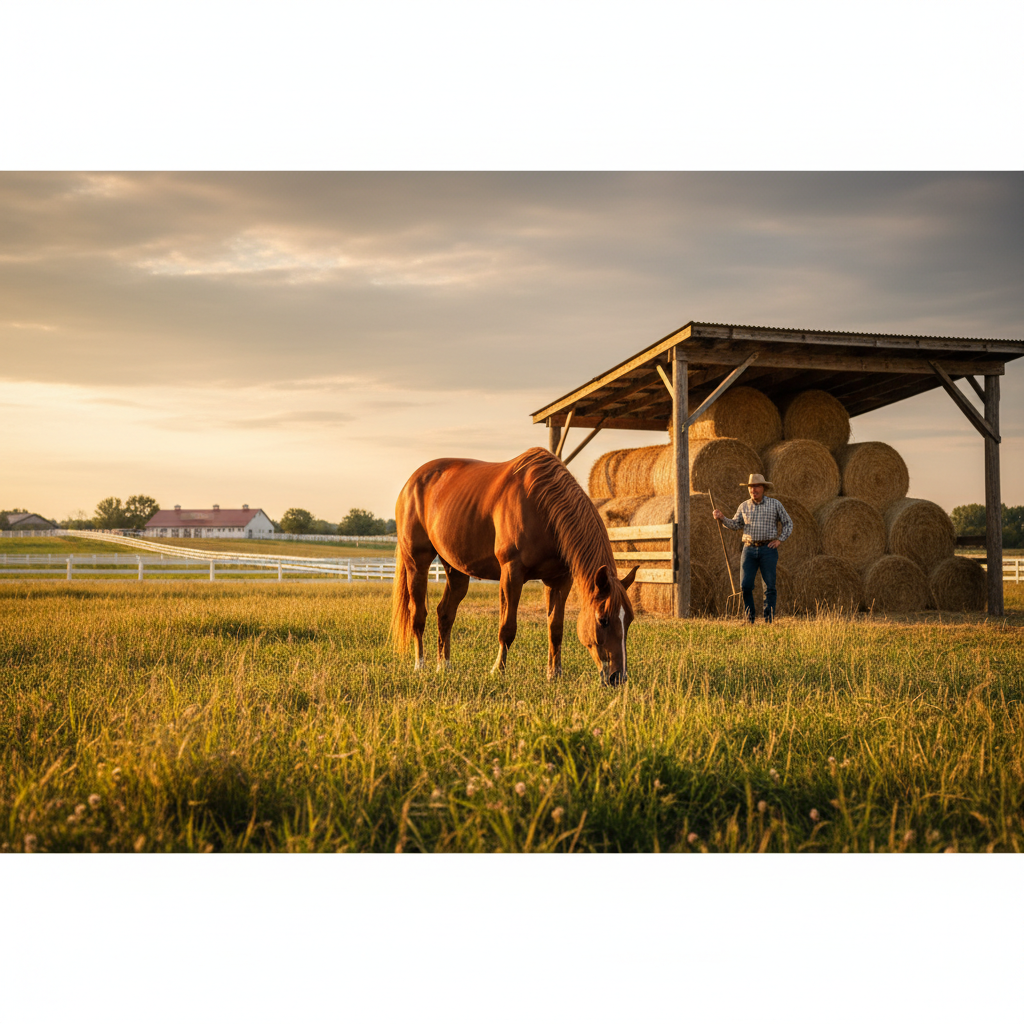
This article is educational and is not a ration prescription. Test your hay, weigh your horse, and work with a veterinarian or equine nutritionist if the horse is metabolic, thin, or has dental disease.
Forage is the foundation of an adult horse's diet. What it needs is a current body weight, a hay test when you can get one, and prices that actually apply where you buy hay.
Alberta Agriculture's Nutrition and Feeding Management for Horse Owners (Agdex 460/51-1, 2008) treats a source of fibre as essential and says it should not be lower than one percent of body weight, to protect the digestive tract. That is a minimum, not a typical ration. University of Minnesota Extension (reviewed 2023–2024) plans most adults at about 1.5 to 2.5 percent of body weight in feed per day, with 2 percent a common target for a typical idle horse, and with most of that as forage. A 1,000-pound horse on 20 pounds of hay a day will eat about 7,300 pounds, or 3.6 tons, in a year. For the daily math, see How Much Hay Does a Horse Eat a Day?. Run the numbers in the horse feed calculator and the hay bale cost calculator.
What official 2026 hay prices can tell you
Alberta Agriculture and Irrigation, October 2026 farm-input survey (published 5 November 2026): $173.43 per ton, farm gate, for good-quality hay with more than 50 percent alfalfa, a simple provincial average. That compares with $199.51 in October 2025 and $170.54 in September 2026. The survey table uses "ton" for hay and does not further define the unit. This is not your neighbour's small-square price, and it is not a 2026 "horse hay" exclusive index. Details, and how to budget a bale, are in Alberta Hay Prices in 2026. For waste and storage, see Small Square vs. Round Bales for Horses.
Equestrian Canada's 2022 Table 6 puts Alberta recreation feed at $2,417 per equine per year — a whole feed basket, in 2022 dollars, before sales tax, not a 2026 hay invoice.
Pasture is seasonal in Alberta
A "pasture and hay" article written for a generic U.S. climate understates the hay bill in Alberta. Agdex 460/50-1 (issued 1975) describes a western Canada pasture season of about 3 to 4 months, compared with 7 to 8 months in some other regions, and it offers planning figures of 1.5–2.5 hectares (4–6 acres) of cultivated pasture per horse per summer, or 3–5 hectares (8–12 acres) of native pasture per season. Those are official, dated planning figures, not a 2026 carrying-capacity survey. The pasture stocking calculator and How Many Acres Does a Horse Need in Alberta? walk through the math, including dry lots of at least 400 square feet per horse (University of Minnesota).
Cool-season grasses (timothy, brome, orchardgrass, and similar) and grass-legume mixes are the usual northern forage conversation; warm-season pastures that dominate a southern U.S. article are not the default here. When you evaluate a stand, look at weeds, bare soil, and residual height, and pull horses off before they graze it into dirt. Agdex 460/50-4 (reviewed August 2009) is blunt that a drought-stricken pasture produces less forage, which means fewer horses or less turnout.
Hay types, testing, and easy keepers
Grass hay, mixed grass-legume, and alfalfa all have a place. Minnesota's example of an average grass hay at 0.91 megacalories per pound versus a mixed grass-legume hay at 1.06 megacalories per pound is useful: if an adult needs 16 megacalories a day, that is 18 pounds of the grass hay or 15 pounds of the mixed hay. If the two are the same price per ton, you feed less of the mixed hay. Protein, calcium, and NSC vary with species and maturity; they belong on a hay test, not in a guessed table. Minnesota has said testing costs about $20 per sample — a Minnesota figure, not a Canadian lab list. Use a local lab and the same logic.
For overweight or metabolic horses, later-cut grass hay and limited pasture are common starting points, but any carbohydrate cutoff should be a veterinary conversation plus a test — labs do not all use the same method, and a single assumed percentage is not a ration. Body condition belongs on the Henneke scale. Seniors who cannot chew long-stem hay need a different fibre source; see Feeding the Senior Horse.
Do not feed moldy hay. Round bales can work for horses if storage and a feeder control waste and weather; they are not automatically cheaper once you count spoilage. Straw is a fibre filler, not a complete forage, unless a nutritionist has designed that diet.
FAQ
How often should I test hay? The official sources used here do not set a single calendar. Test when the lot changes, and whenever you are balancing a diet for a metabolic, growing, or thin horse. Minnesota notes that results are often back in a few days.
Can I feed moldy hay if I pick out the moldy parts? No. Discard moldy hay. Do not invent a "safe" mold percentage.
Are round bales safe for horses? They can be, with a feeder, dry storage, and a hard look at waste. See the square-versus-round article rather than assuming a price advantage.
What is dry matter on a hay analysis? It is the hay with moisture removed, so you can compare lots. OMAFRA has used a 90 percent dry-matter assumption for dry hay in some examples. Feed the as-fed amount your horse can actually eat.
My horse is overweight. What hay should I feed? Usually a tested grass hay, with calories and turnout set to a body condition score, not a crash diet. Involve your veterinarian if the horse is metabolic or laminitis-prone.
Sources
- Alberta Agriculture and Rural Development, Nutrition and Feeding Management for Horse Owners (Agdex 460/51-1, 2008). https://www1.agric.gov.ab.ca/$Department/deptdocs.nsf/all/agdex12189/$FILE/460_51-1.pdf
- Alberta Agriculture and Irrigation, Alberta Farm Input Prices, October 2026 (published 5 November 2026). https://open.alberta.ca/dataset/f2432af0-cffa-4a86-9c31-74e6ec5c5afa/resource/d5a293ae-2d95-40d5-933d-035cb6ba4bf1/download/agi-tedab-monthly-farm-input-prices-2026-10.pdf
- University of Minnesota Extension, "Using hay in horse diets" (reviewed 2023) and "Ten ways to stretch your horse's hay supply" (reviewed 2024). https://extension.umn.edu/agriculture/animals-and-livestock/horse/hay-in-horse-diets and https://extension.umn.edu/agriculture/animals-and-livestock/horse/stretch-hay-supply
- Equestrian Canada, Socio-Economic Impact Assessment, Table 6 (2022). https://equestrian.ca/wp-content/uploads/2024/05/EC-Impact-Assessment-Supplementary-Information.pdf
- Alberta Agriculture, The Horse: Pasture and Feeding, Agdex 460/50-1 (issued 1975); Feeding and Management Considerations for Horses, Agdex 460/50-4 (reviewed August 2009).
This article is general information, not veterinary advice. Talk to your veterinarian about your horse.